 HYGO News
Biden Rips Extending Trump Tax Cuts: 'Guess Who Gets It? You All Don't' (February 14, 2023)
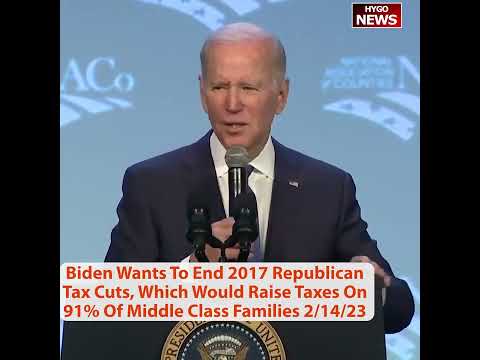
President Joe Biden told county officials gathered in Washington that the Trump tax cuts weren’t for people like them. “They want to extend the Trump tax cuts from the previous 4 years, which cost $2.7 trillion to the deficit, and extend it,” he said of congressional Republicans. “And guess who gets it? You all don’t” [1].
The record says otherwise for most of middle America. The nonpartisan Tax Policy Center estimated that in 2018, 91% of middle-income households got a tax cut from the 2017 law [2]. The video above shows Biden’s line from his Feb. 14, 2023, speech to the National Association of Counties Legislative Conference at the Washington Hilton. Quotes are from the official transcript published by the American Presidency Project [1].
”Guess Who Gets It? You All Don’t”
Biden built up to the line by listing what he said Republicans wanted to undo. He said they wanted to cut the money “to crack down on tax cheats,” which he said the Congressional Budget Office estimated would cost “another $114 billion in lost revenue.” He warned they would repeal Medicare drug-price negotiation, the 15% corporate minimum tax, which he said would “add $222 billion to the deficit,” and the 1% tax on stock buybacks, which he said would cost “$74 billion more on the deficit” [1].
Then he turned to the 2017 Tax Cuts and Jobs Act, signed by President Donald Trump, whose individual cuts were set to “sunset after 2025” [6]. Those tax cuts, he said, “cost $2.7 trillion to the deficit,” and Republicans wanted to “extend it. And guess who gets it? You all don’t” [1].
Who Actually Got the Trump Tax Cuts
The Tax Policy Center, “a joint venture of the Urban Institute and Brookings Institution,” ran the numbers on the final 2017 bill [6]. Its findings for 2018 [2]:
- Most Americans got a cut: “In 2018, 80 percent of taxpayers would receive a tax cut from the included provisions—averaging about $2,100—and about 5 percent would face an average tax increase.”
- The middle class got one too: “In the middle income quintile, 91 percent would receive a tax cut and 7 percent would face a tax increase.”
- The dollars: “Taxpayers in the middle income quintile would receive an average tax cut of about $900, or 1.3 percent of after-tax income.”
- Every group: The bill “would reduce taxes on average for all income groups in both 2018 and 2025.”
The same analysis found the biggest cuts as a share of income went to the top. “In general, higher income households receive larger average tax cuts as a percentage of after-tax income, with the largest cuts as a share of income going to taxpayers in the 95th to 99th percentiles of the income distribution,” TPC wrote [2]. It also warned what would happen once the individual cuts expired: “Compared to current law, 5 percent of taxpayers would pay more tax in 2018, 9 percent in 2025, and 53 percent in 2027” [2].
The $400,000 Promise
Biden’s line raised an obvious question for the middle-income families who got those cuts: what happens to them if the cuts expire? A week earlier, in his State of the Union address, Biden had drawn his line: “Under my plans, as long as I’m President, nobody earning less than $400,000 will pay an additional penny in taxes. Nobody. Not one penny” [3].
TPC’s projection that 53% of taxpayers would pay more in 2027 under the law as written, “largely because almost all individual income tax provisions would sunset after 2025,” showed what was at stake [2][6].
A Budget Promise and a Debt-Limit Warning
Biden used the rest of the speech to set up his coming budget fight with House Republicans. “When I introduce a budget 3 weeks from now, a few weeks from now—May—I guess, March 9—you’re going to see we’ll cut the deficit by another $2 trillion in the next 10 years,” he said. “I’m simply not going to let the Nation default on its debt for the first time in history” [1].
He also took a shot at corporate America from his home state: “I come from the corporate capital of the world: Delaware. No, not joking.” And he offered a number on executive pay that he hedged as he said it: “So 90—I think it’s 91 percent of all corporate execs are paid by stock—in stock” [1].
For how the debt-limit standoff with Republicans played out that spring, see HYGO News’ report on Press Secretary Karine Jean-Pierre’s insistence that the White House “will not negotiate”.
By the Numbers
- 91%: middle-income households that got a tax cut in 2018 under the 2017 law, per TPC [2].
- 80%: all taxpayers who got a cut in 2018, averaging about $2,100 [2].
- About $900: the average 2018 tax cut for the middle income quintile [2].
- 53%: taxpayers TPC projected would pay more in 2027 under the law as written, after the individual cuts expired [2].
- $400,000: the income line under which Biden promised no new taxes [3].
- 37%: the top income tax rate for 2026 listed by the IRS under the 2025 tax law [4].
What Happened Next
Biden never got to decide. He left office in January 2025, the last year before the 2017 law’s individual cuts were set to sunset [6].
Trump made them stick. The One, Big, Beautiful Bill became Public Law 119-21 on July 4, 2025 [5]. For 2026, the IRS’s guide to the law’s provisions for individuals lists seven brackets from 10% to 37%, with the standard deduction at $32,200 for married couples filing jointly and $16,100 for single filers [4]. Without the new law, the 2017 law’s individual cuts would have expired, the scenario TPC said would raise taxes on a majority of taxpayers [2].
Sources
- The American Presidency Project: Remarks at the National Association of Counties Legislative Conference (February 14, 2023)
- Tax Policy Center: Distributional Analysis of the Conference Agreement for the Tax Cuts and Jobs Act (December 18, 2017, archived copy)
- The American Presidency Project: Address Before a Joint Session of the Congress on the State of the Union (February 7, 2023)
- Internal Revenue Service: Working Families Tax Cuts, provisions for individuals and workers
- Internal Revenue Service: FAQs for modification of sections 25C, 25D, 25E, 30C, 30D, 45L, 45W and 179D under Public Law 119-21 (July 4, 2025), the One, Big, Beautiful Bill
- Tax Policy Center: Distributional Analysis of the Conference Agreement for the Tax Cuts and Jobs Act, full report PDF (December 18, 2017, archived copy)