 HYGO News
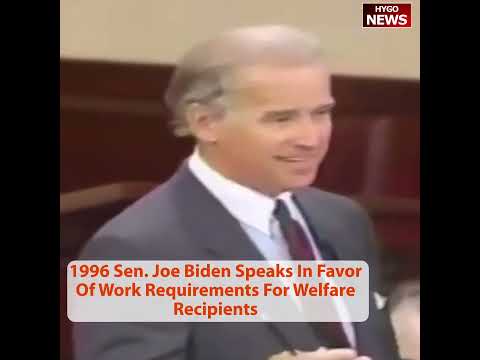
Biden in 1996: 'I Was Pilloried by My Colleagues on the Democratic Side' for Mandatory Work Requirements (July 18, 1996)
In May 2023, with the debt ceiling deadline closing in, President Joe Biden was asked whether he would accept tougher work requirements for government aid. “I voted for tougher aid programs that’s in the law now, but for Medicaid it’s a different story,” he said in Rehoboth Beach, Delaware, on May 14 [2].
Three days later, he drew a line. “I’m not going to accept any work requirements that go much beyond what is already—what I—I voted years ago for the work requirements that exist. But it’s possible there could be a few others, but not anything of any consequence,” Biden said [3].
Twenty-seven years earlier, Sen. Joe Biden of Delaware sounded different. On the Senate floor during the 1996 welfare reform debate, he took credit for the idea. “I proposed a concept of welfare to work in 1987, and I was pilloried by my colleagues on the Democratic side at the time for suggesting that there be mandatory a work requirement for anyone receiving welfare,” the official Congressional Record says [1].
The video above shows Biden’s July 18, 1996, Senate remarks. Quotes are from the official Congressional Record, which members may edit, and the transcripts published by the American Presidency Project [1][2][3].
”Put Them to Work”
Biden told the Senate that welfare reform was about more than money. “We hear speech after speech after speech about changing the ethic that is involved in the welfare syndrome. We just heard our good friend from North Carolina talking about the generational nature of this problem and how to break the spiral, and so on,” he said [1].
“Part of this effort is to, in fact, not just take people off of welfare and put them on the streets, but put them to work and make them want to go to work and make it reasonable for them to go to work,” Biden said [1].
“I respectfully suggest it is not just about money. It is about changing attitudes,” he said [1].
”The Biden-Specter Bill”
Biden was offering a bipartisan substitute with Pennsylvania Republican Arlen Specter. “My colleagues will probably know it as the Castle-Tanner welfare reform bill. I, frankly, like to call it the Biden-Specter bill because Senator Specter and I did introduce it on the Senate side,” he said [1].
He listed what was in it. “Block grants to the States, a 5-year time limit, work requirements, child care, and child-support enforcement,” Biden said [1].
His plan would make every recipient sign up front. “The Biden-Specter bill says that anyone who wants to receive welfare must sign an individual responsibility contract, so that they are forced to agree up front to the conditions placed on receiving the benefit,” he said [1].
He admitted he did not like every part of the deal. “I do not like the idea that we are block granting welfare and that it is no longer an entitlement,” Biden said, calling the deal “a genuine compromise” [1].
He blamed both parties for the delay. “Both sides of the aisle have been using welfare reform as a political football, and we have accomplished nothing thus far,” Biden said. “If we really want welfare reform, and not a political issue, we must do it in a bipartisan way.” [1]
He also argued for a year of extra health coverage for people leaving welfare. “Welfare recipients are not stupid; they know most of the jobs will not have any health insurance for their kids,” he said [1].
”Breaks the Budget”
Biden’s “senior colleague from Delaware,” Sen. William Roth, who had steered the leadership bill through the Finance Committee, thanked him and then opposed the substitute. “The substitute also opens up the Federal checkbook for a $3 billion work program,” Roth said. “In other words, the Specter-Biden substitute breaks the budget.” [1]
By the Numbers
- 1987: the year Biden said, in the Congressional Record, he proposed welfare to work [1].
- 5 years: the time limit on welfare in his bill [1].
- $53.1 billion: the savings his bill was estimated to achieve [1].
- 80 hours: the monthly work, service or job-training rule for some adults in Medicaid under the 2025 law [5].
What Happened Next
Biden signed new SNAP work rules. The debt ceiling deal Biden signed on June 3, 2023, the Fiscal Responsibility Act, raised the age at which adults are exempt from food stamp work requirements. Under the law, the exemption covers those “over 55 years of age” starting in fiscal 2025 [4].
The law also added exemptions for “a homeless individual,” “a veteran” and certain young adults who aged out of foster care, and the changes “shall cease to have effect on October 1, 2030” [4].
Trump made Medicaid work requirements law. On July 4, 2025, President Donald Trump signed Public Law 119-21. Its Section 71119, part of a subchapter titled “Increasing Personal Accountability,” requires states to set “Medicaid community engagement requirements for certain individuals.” An adult can meet the rule if “the individual works not less than 80 hours” a month, or does 80 hours of community service or a work program [5].
For another Biden-era fight over government programs, see HYGO News’ page on the Social Security and Medicare question.
Sources
- Congressional Record: Personal Responsibility, Work Opportunity, and Medicaid Restructuring Act of 1996 (July 18, 1996), Senate, pages S8105-S8131
- The American Presidency Project: Remarks in an Exchange With Reporters in Rehoboth Beach, Delaware (May 14, 2023)
- The American Presidency Project: Remarks on the Public Debt Limit and an Exchange With Reporters (May 17, 2023)
- GovInfo: Public Law 118-5, Fiscal Responsibility Act of 2023 (June 3, 2023)
- GovInfo: Public Law 119-21 (July 4, 2025)