 HYGO News
 Hillary Clinton 2026: 'I never met Jeffrey Epstein'; Bill Clinton in 1998: 'I want you to listen to me'
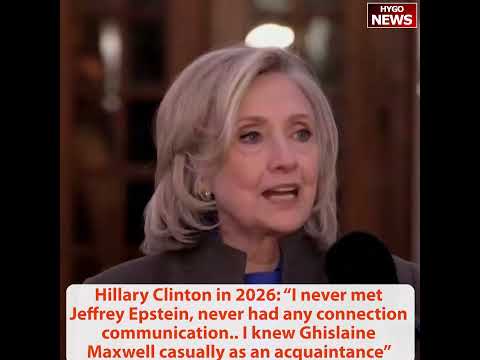
Hillary Clinton 2026: ‘I never met Jeffrey Epstein’; Bill Clinton in 1998: ‘I want you to listen to me’
Hillary Clinton emerged from closed-door testimony before the House Oversight Committee probing the Jeffrey Epstein case and delivered a categorical denial of any connection to the late sex trafficker. Clinton also minimized her relationship with Ghislaine Maxwell, Epstein’s convicted accomplice now serving 20 years in federal prison for child sex trafficking. The clip from Clinton’s post-testimony statement was paired against her husband’s infamous 1998 denial of an affair with Monica Lewinsky — a side-by-side that has generated intense discussion given the Clinton family’s history of emphatic public denials that later required revision. Hillary Clinton: “I have just finished testifying. I never met Jeffrey Epstein, never had any connection or communication with him. I knew Ghislaine Maxwell casually as an acquaintance.” Bill Clinton in 1998: “I want you to listen to me. I’m going to say this again. I did not have sexual relations with that woman, Miss Lewinsky.” The Clintons’ pattern of denial has re-emerged as a political issue as the Epstein files release continues and as Congressional investigators probe the network of powerful figures who interacted with Epstein, Maxwell, and their victims.
Hillary’s Denial
“I have just finished testifying. I never met Jeffrey Epstein, never had any connection or communication with him.”
Hillary Clinton’s statement was categorical. No meeting. No connection. No communication. The absolute framing leaves no room for revision if evidence emerges.
“I knew Ghislaine Maxwell casually as an acquaintance.”
Clinton acknowledged knowing Maxwell — unavoidable given photographic evidence of their interactions at various social events. “Casually as an acquaintance” minimizes the relationship without denying it existed.
Maxwell in Context
Ghislaine Maxwell:
- Daughter of media tycoon Robert Maxwell
- Epstein’s longtime companion and accomplice
- Convicted December 2021 of child sex trafficking
- Serving 20-year federal sentence
- Ran the operational side of Epstein’s trafficking network
Maxwell’s social circle included Clintons, Prince Andrew, Trump (at various points), and much of New York, London, and Palm Beach society. Her position at social events was unavoidable for the Clintons given their active role in charity and diplomatic circles during the 1990s and 2000s.
Bill Clinton’s Denial
Bill Clinton’s January 26, 1998 statement to the press remains one of the most iconic political denials in American history.
“I want you to listen to me. I’m going to say this again. I did not have sexual relations with that woman, Miss Lewinsky.”
The context:
- Allegations of affair between Clinton and White House intern Monica Lewinsky
- Clinton’s public denial preceded impeachment proceedings
- Clinton later acknowledged the relationship was “not appropriate”
- Grand jury testimony and impeachment followed
- Clinton became second U.S. president impeached (acquitted by Senate)
The denial became a symbol of presidential deception. Clinton’s careful parsing of “sexual relations” — arguing the legal definition excluded the specific acts involved — damaged public trust.
The Pattern Question
The pairing of Hillary and Bill Clinton’s denials raises pattern questions. The Clintons have faced numerous allegations across decades:
- Whitewater (land deal investigation)
- Travelgate (White House travel office firings)
- Filegate (FBI file access)
- Chinagate (campaign finance)
- Uranium One (Russia uranium sale connection)
- Clinton Foundation operations
- Email server practices
- Benghazi consulate attack response
- Multiple Epstein social interactions
Each episode involved Clinton denials. Some proved accurate, others required subsequent qualifications.
Epstein Flight Logs
Bill Clinton’s connection to Epstein is more complicated than Hillary’s. Flight logs from Epstein’s Boeing 727 (the “Lolita Express”) show:
- Multiple Clinton flights on Epstein’s aircraft
- Destinations including Africa, Europe, and the Caribbean
- Secret Service protection records matching some flights
- At least 26 flights per some reconstructions
Bill Clinton has acknowledged using Epstein’s plane for Clinton Foundation work but denied any involvement with or knowledge of Epstein’s trafficking operation.
Hillary Clinton’s claim is distinct — no flights, no meetings, no connection. If flight logs or other records contradict this, her testimony could create legal exposure.
Epstein Files Release
The Epstein files release — authorized under the One Big, Beautiful Bill — has put thousands of pages of documents into public view. The Justice Department has been rolling out productions including:
- FBI interview notes
- Email exchanges
- Flight logs
- Financial records
- Victim statements (redacted)
- Photographs from Epstein properties
Names mentioned in the files include politicians, business figures, celebrities, academics, and foreign dignitaries. Being named does not imply wrongdoing — many were acquaintances rather than participants.
Congressional investigators are comparing testimony (like Hillary Clinton’s) against documentary evidence. Any contradictions become potential perjury questions.
Testimony Framework
Hillary Clinton’s appearance was voluntary — she was not subpoenaed. Voluntary testimony under closed-door framework means:
- No public cross-examination
- Transcript release typically delayed
- Strategic flexibility in statements
- Selective post-testimony comments
- Framework controlled by witness and counsel
The “I have just finished testifying” opening establishes Clinton’s narrative ahead of any documentary contradiction. If flight logs later surface showing contact, she can claim memory failure rather than false statement.
The Political Context
Hillary Clinton at 78 years old in 2026 remains politically significant. Her 2016 presidential loss to Trump still shapes Democratic politics. Her connections to the Clinton Foundation, DNC operations, and various political networks make her testimony politically relevant.
The 2026 midterm context:
- Democrats struggling with Trump’s popularity
- Epstein files cutting against various establishment Democrats
- Mamdani socialism faction competing with Clinton centrism
- Clinton family legacy under renewed scrutiny
Media Coverage Contrast
Mainstream media coverage of Hillary Clinton’s Epstein testimony has been minimal compared to coverage of Trump-Epstein associations. The asymmetry has been noted by conservative media and independent commentators.
When Trump has been documented as having known Epstein (decades-old photos, Mar-a-Lago interactions), coverage has been extensive. When Clintons face similar documentation, coverage is briefer and framed as past associations.
Ghislaine Maxwell Cooperation
Ghislaine Maxwell, serving her 20-year sentence, has reportedly provided cooperation to federal investigators and Congressional committees. Her cooperation may include:
- Details of Epstein’s network
- Names of powerful figures who interacted with victims
- Financial structures of the operation
- Island operations (Little St. James)
- Palm Beach estate activities
If Maxwell’s cooperation contradicts Hillary Clinton’s testimony, Clinton could face perjury exposure.
The 1998 Precedent
Bill Clinton’s 1998 denial carries weight because it was later contradicted by evidence. The pattern — emphatic denial, subsequent evidence, qualified acknowledgment — has become a Clinton family trademark.
Hillary’s 2026 denial — “never met Jeffrey Epstein, never had any connection or communication with him” — follows the same structural pattern as Bill’s 1998 denial. Both use absolute language that leaves no wiggle room.
Whether Hillary’s statement survives documentary examination will determine whether the pairing is fair or unfair. If she genuinely never met Epstein (possible — they moved in overlapping but distinct circles), her statement stands. If documentary evidence emerges showing contact, the Bill-Hillary parallel will be cemented.
Significance
The Hillary Clinton testimony and its pairing with Bill Clinton’s 1998 Lewinsky denial serve multiple political functions:
For Republicans — documentation that Clintons deny involvement with Epstein network. If later evidence emerges contradicting Hillary, the denial becomes foundation for perjury charges or political attacks.
For Democrats — complication for any Clinton-style political revival. Hillary’s testimony has been filed; any future political activity carries the Epstein testimony as potential liability.
For the public — continuing examination of the Epstein network and the political figures who orbited it. The transparency required by the Epstein files legislation continues to produce revelations.
Key Takeaways
- Hillary Clinton on Epstein: “I have just finished testifying. I never met Jeffrey Epstein, never had any connection or communication with him.”
- Hillary Clinton on Maxwell: “I knew Ghislaine Maxwell casually as an acquaintance.”
- Bill Clinton 1998 parallel: “I want you to listen to me. I’m going to say this again. I did not have sexual relations with that woman, Miss Lewinsky.”
- Pattern context: Both Clintons use absolute denial language that leaves no room for later qualification — the pattern that preceded Bill Clinton’s 1998 impeachment.
- Political stakes: Hillary Clinton’s testimony is on record; any documentary contradiction from Epstein flight logs, Maxwell cooperation, or released FBI files could create perjury exposure.