 HYGO News
 LAPD says no probable cause for arson suspect; Dem Speaker of CA State Turns Into Stuttering Mess
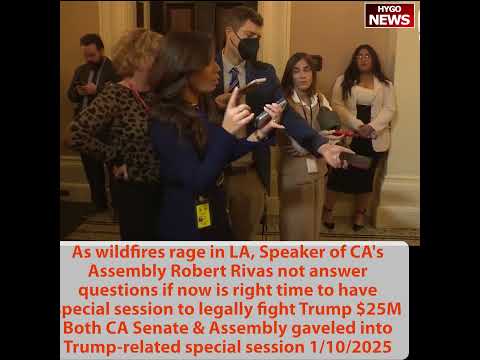
LAPD says no probable cause for arson suspect; Dem Speaker of CA State Turns Into Stuttering Mess
As the Los Angeles wildfires raged in January 2025, two stories captured the dysfunction of the crisis response: LAPD announced it found no probable cause for arson against a man caught with a blowtorch trying to ignite fires in a residential neighborhood, and California State Assembly Speaker Robert Rivas dissolved into a stuttering mess when a reporter confronted him about holding a special legislative session to fight Donald Trump while the most destructive fire in the city’s history was burning.
Arson Suspect with Blowtorch Released
In one of the most infuriating developments of the wildfire crisis, LAPD determined there was no probable cause for arson charges against a man who had been arrested with a blowtorch while allegedly attempting to ignite fires in a residential area.
The incident occurred in the Woodland Hills area of Los Angeles, near Arcos Drive and Galendo Street. Citizens reported seeing a man attempting to use a blowtorch to set fire to Christmas trees and garbage in the neighborhood. The timing was particularly alarming: the Kenneth Fire had erupted late Thursday afternoon in the nearby San Fernando Valley and was spreading through the West Hills, and residents in the area were already on high alert.
Local residents did not wait for police to respond. They tackled the man, who was seen holding what appeared to be a blowtorch or flamethrower, and physically restrained him on the ground until authorities arrived. The citizens’ willingness to intervene reflected the level of fear and vigilance that had gripped the community as fires burned across the Los Angeles basin.
Despite the circumstances — a man physically caught with a blowtorch attempting to set fires during the worst wildfire crisis in the city’s modern history — LAPD determined that there was no probable cause to charge the suspect with arson. The suspect’s name was not released to the public.
The decision sparked outrage among residents and commentators who questioned how a person could be caught in the act of attempting to ignite fires with an incendiary device and walk free without charges. The LAPD’s finding raised questions about the evidentiary standards being applied and whether the threshold for arson charges was being set unreasonably high during a period when deliberate fire-setting posed an existential threat to entire neighborhoods.
The Kenneth Fire Connection
The blowtorch incident occurred at roughly the same time as the eruption of the Kenneth Fire, which broke out in the San Fernando Valley. The proximity in both time and geography between the attempted arson and the new fire raised questions about whether the two events were connected, though no official link was established.
The Kenneth Fire added to the overwhelming burden on the Los Angeles Fire Department, which was already stretched thin fighting the Palisades Fire and the Eaton Fire simultaneously. The emergence of yet another fire in a different part of the city further depleted resources and heightened fears that arsonists might be deliberately exploiting the crisis.
Assembly Speaker Rivas’s Special Session Debacle
The second story captured an equally striking moment of misplaced political priorities. As the most destructive wildfire in Los Angeles history was burning, the California State Assembly gaveled into a special legislative session — not to address the fire crisis, but to prepare for the incoming Trump administration.
Both the California Senate and Assembly had convened the special session to allocate $25 million to the state’s Justice Department specifically to fund legal battles against the Trump administration. The timing of the session, with fires still raging and residents still displaced, drew immediate criticism.
KRCA News California Capitol Correspondent Ashley Zavala confronted Assembly Speaker Robert Rivas directly: “Is now the right time to have a special legislative session on allocating money to fight Trump in a way that you could already do without a special legislative session?”
Rivas’s response was visibly uncomfortable. He stammered through his answer: “I’m here to address these-these-these-these wildfires — this is a historic wildfire.” The repeated stumbling over the word “these” became an instant symbol of a politician caught between his actual agenda and the crisis his constituents were living through.
Zavala pressed further, noting the contradiction in sharp terms: “But minutes ago, your house — while the wildfires are happening and while people are trying to understand what’s going on and are worried about disaster relief, worried about the ability to get homeowners insurance — your chamber gaveled into a special legislative session to prepare for Donald Trump in a way you are already able to do without a special legislative session. So again, is now the right time for that?”
Rivas continued to stutter as he attempted to read prepared talking points about supporting recovery efforts. The contrast between his stated focus on the wildfires and the session’s actual purpose — fighting Trump — was impossible to paper over.
The Priorities Question
The juxtaposition of the two stories captured a crisis within a crisis. On one hand, a man caught with a blowtorch trying to start fires was released without charges. On the other, the state legislature was using the crisis as a backdrop while actually focused on political opposition to the incoming president.
The $25 million allocation to fight Trump was particularly pointed. At a time when the fire department was under-resourced, fire hydrants were running dry, and entire neighborhoods had been reduced to ash, the legislature’s decision to prioritize funding for legal battles against a political opponent over direct disaster response seemed to confirm the critique that California’s Democratic leadership had fundamentally misaligned priorities.
Zavala’s question — whether the legislature could already do what the special session was meant to accomplish without the session — highlighted the performative nature of the exercise. If the state’s Justice Department could already pursue legal challenges to the Trump administration without a special session, then the session itself served no practical purpose beyond political messaging. Holding that political messaging event while Los Angeles burned was, in the eyes of critics, a profound failure of judgment.
Key Takeaways
- LAPD found no probable cause for arson against a man caught with a blowtorch attempting to ignite fires near Woodland Hills during the wildfire crisis; his name was not released.
- Citizens physically tackled and restrained the suspect until police arrived, as the Kenneth Fire was simultaneously erupting in the nearby San Fernando Valley.
- California Assembly Speaker Robert Rivas stammered through an attempted defense of holding a special session to allocate $25 million to fight Trump while the wildfires burned.
- Reporter Ashley Zavala pressed Rivas on whether the special session was necessary at all, noting the legislature could already pursue anti-Trump legal actions without one.
- The juxtaposition of a released arson suspect and a legislature focused on political opposition rather than disaster response highlighted the criticism of misplaced priorities.