 HYGO News
 Legal Scholar: weaponization of their once-vaulted legal system, patent constitutional error
Legal Scholar: weaponization of their once-vaulted legal system, patent constitutional error
Following President-elect Trump’s sentencing hearing on January 10, 2025, legal scholars Andy McCarthy and Jonathan Turley delivered pointed analysis of the Manhattan case, with McCarthy arguing that “patent constitutional error” invalidated the jury’s verdict and Turley declaring the sentencing “the final gavel fall on a system that allowed it to be used for political purposes.” Both analysts predicted the case would eventually reach the Supreme Court and described the prosecution as a historic low point for the New York court system.
McCarthy on Constitutional Error
Former federal prosecutor Andy McCarthy, who had been one of the most prominent legal critics of the Manhattan prosecution, laid out the central constitutional flaw he saw in the case. McCarthy focused on the jury instructions, arguing that the jury had not been asked to unanimously agree on the underlying crime that elevated the charges from a misdemeanor to a felony.
“We could talk about probably a dozen different reversible errors in this case,” McCarthy began, “but the jury was not asked to find unanimously the crime that Trump was supposedly covering up when he allegedly falsified his business records.”
McCarthy explained why this mattered. “It’s a bedrock principle of the criminal law that if it’s a fact that is going to drive the sentence, and we’re talking now about the fact that turned this — what’s ordinarily a misdemeanor in New York law — into a felony, if it’s that kind of a fact that’s that consequential for sentencing, it has to be found unanimously by the jury, and this jury didn’t.”
The argument went to the heart of the prosecution’s legal theory. Manhattan DA Alvin Bragg had charged Trump with falsifying business records, which under New York law is a misdemeanor. To elevate the charge to a felony, the prosecution had to prove that the falsification was committed in furtherance of another crime. The jury was given multiple options for what that underlying crime might have been and was not required to agree unanimously on which one applied — a structure that McCarthy argued violated fundamental constitutional protections.
“No one in his right mind thinks that you have to give voice to a jury verdict when there’s patent constitutional error in the case,” McCarthy concluded.
The Colangelo Connection
The legal discussion also addressed the politically sensitive connection between the Manhattan DA’s office and the federal Department of Justice. Matthew Colangelo had left his position as a deputy or assistant attorney general at the DOJ to join the Manhattan District Attorney’s office and take a leading role in the Trump prosecution.
“That was something that a lot of people said draws a direct connection between what’s going on in New York City and what’s going on at 1600 Pennsylvania Avenue,” the analysis noted. The movement of a senior DOJ official into a state prosecutor’s office specifically to work on a case against the sitting president’s political opponent was, in the eyes of critics, evidence that the prosecution was coordinated at the federal level rather than arising organically from state-level concerns.
The Colangelo factor had been a recurring theme in Trump’s own remarks at the sentencing hearing, where he pointed to “a gentleman sitting right there from the DOJ” and described the movement of personnel between federal and state offices as part of a coordinated political operation.
Turley on the New York Court System
Georgetown law professor Jonathan Turley, one of the most frequently cited legal commentators on the case, offered a broader institutional assessment. Turley argued that the sentencing was not just a verdict on Trump but a verdict on the New York court system itself.
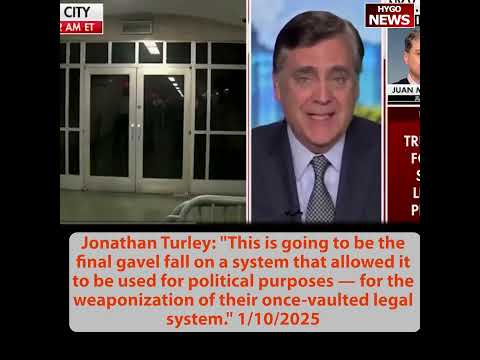
“I think the ultimate verdict that will come in today is not the verdict the jury delivered months ago, but a verdict on the New York court system,” Turley said. “This is going to be the final gavel fall on a system that allowed it to be used for political purposes — for the weaponization of their once-vaulted legal system.”
Turley expressed a sense of institutional loss. “New York used to be the premier system, and many of us are still in astonishment as to how this legal system allowed these cases to go this far,” he said. The comment reflected a view shared by numerous legal observers that New York’s courts — once regarded as among the most sophisticated and respected in the country — had damaged their reputation by allowing a case that many scholars considered legally novel at best and politically motivated at worst.
The Absence of Punishment
Both analysts pointed to the sentencing outcome itself as evidence of the case’s fundamental weakness. Judge Merchan declined to impose any punishment — no jail time, no fine, no probation. Turley argued that this outcome spoke volumes.
“The fact is that the lack of any real punishment really does capture the absence of substance to this case,” Turley said. “I mean, this case has always been more inflated than the Goodyear blimp.” The comparison was characteristically colorful, but the underlying point was serious: a prosecution that had been described as historic and unprecedented had resulted in no punishment whatsoever, suggesting that even the court recognized the limited gravity of the underlying conduct.
Turley noted the irony of the outcome: “You now have a president who will walk away and go to the White House.” The sentencing had achieved the political goal of labeling Trump a “convicted felon” but had imposed no tangible consequences — an outcome that critics argued exposed the prosecution’s true purpose.
Predictions for Appeal
Both McCarthy and Turley expressed confidence that the case would be reversed on appeal, with Turley predicting it would ultimately reach the Supreme Court.
“I have to say that I think Merchan will guarantee that his court walks into a degree of infamy with this decision,” Turley said. “This was a made-up crime that should never have been allowed to go to trial. He then had layers of reversible error in order to get this to the point of today where he could call the incoming president a convicted felon.”
Turley predicted that the institutional damage would fall more heavily on the court system than on Trump. “I think the judgment will be far harsher for the New York court system than it will be on President-elect Trump,” he said. “I think there’s a very good chance that this could be reversed. There’s not a lot of hope that the New York court system will redeem itself.”
In his most vivid characterization, Turley described the accumulated legal errors as a “peddler’s wagon of reversible errors” that would “pull up in front of the United States Supreme Court. And I think they’re going to find it a very hard case to make in front of those justices.”
Key Takeaways
- Andy McCarthy argued the jury was never asked to unanimously find the underlying crime that elevated the charges from a misdemeanor to a felony, constituting “patent constitutional error.”
- Jonathan Turley called the sentencing “the final gavel fall” on a legal system that allowed itself to be weaponized for political purposes.
- Both analysts pointed to the DOJ connection through Matthew Colangelo as evidence of coordination between federal and state prosecutors.
- Turley said the lack of any punishment “captures the absence of substance to this case,” comparing the prosecution to the Goodyear blimp.
- Both predicted the case would be reversed on appeal, with Turley saying a “peddler’s wagon of reversible errors” would ultimately reach the Supreme Court.
- Turley argued the institutional damage to the New York court system would be far worse than any impact on Trump.
Transcript Highlights
The following is transcribed from the video audio:
- The jury was not asked to find unanimously the crime that Trump was supposedly covering up when he allegedly falsified his business records.
- No one in his right mind thinks that you have to give voice to a jury verdict when there’s patent constitutional error in the case.
- This is going to be the final gavel fall on a system that allowed it to be used for political purposes — for the weaponization of their once-vaulted legal system.
- New York used to be the premier system, and many of us are still in astonishment as to how this legal system allowed these cases to go this far.
- The lack of any real punishment really does capture the absence of substance to this case. This case has always been more inflated than the Goodyear blimp.
- This peddler’s wagon of reversible errors is going to pull up in front of the United States Supreme Court.
Full transcript: 586 words transcribed via Whisper AI.