 HYGO News
Reporter to Biden's State Department: 'Upset That You're Not Able to Pay Iran'? Ned Price: 'You Didn't Hear Those Words Come Out of My Mouth' (February 24, 2021)
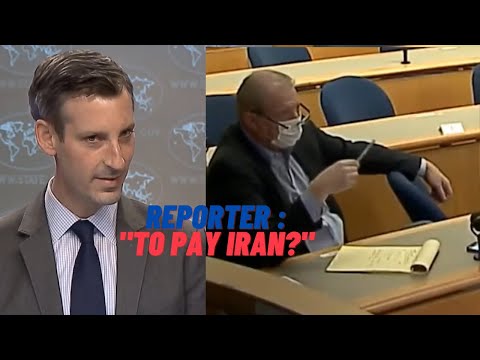
One month into the Biden administration, a reporter at the State Department pressed the new team on the Iran nuclear deal. “You guys, it sounds as though you’re upset that you’re not able to pay Iran to come – after it violates the agreement to come back into compliance because —” the reporter said at the briefing on Feb. 24, 2021, according to the State Department’s transcript [1].
“Matt, you didn’t hear those words come out of my mouth. They came out of your mouth,” spokesman Ned Price shot back. “So yes, Kylie.” [1]
The video above shows the exchange at the Feb. 24, 2021, State Department briefing. Quotes are from the State Department and the American Presidency Project [1][2].
”They Would Actually Get Paid for It”
The reporter Price called Matt had challenged his claim that Iran had kept the deal. “You keep saying that Iran was in complete compliance with the agreement before May 2018, but that’s not entirely the case because the way the – the way the deal was structured, if Iran came out of compliance for any reason, there was a way for them to get back into compliance,” he said [1].
“And so, in fact, there were numerous incidents of non-compliance or what might uncharitably be called violations, particularly with the heavy water production and storage,” the reporter said. “When they exceeded their heavy water production storage, the U.S. and other countries stepped in and bought it, the excess, from them, which meant that if they violated the agreement, they would actually get paid for it.” [1]
“The Great Irony”
Price pointed to the U.S. exit from the deal. “The great irony here, Matt – the great irony of this is that with the United States not in the JCPOA, we no longer have that remedial method,” he said [1].
“You’re no longer able – you’re no longer able to pay the Iranians for violating the agreement?” the reporter asked [1].
“We can’t go back to the Joint Commission and make clear when we think Iran has come into violation of the JCPOA,” Price said. “Iran was complying with the deal. More importantly, Iran was permanently and verifiably prevented from obtaining a nuclear weapon. That’s what we’re going for here.” [1]
“Our Patience Is Not Unlimited”
Price said the clock was running. “One way we look at that is the so-called breakout time, the time it would take Iran to acquire the nuclear material required to build a nuclear weapon if Iran chose to do so. When the JCPOA was in effect, that was at 12 months,” he said [1].
“We are now, according to some published reports, back in that time frame of a few months,” Price said. “So all that to say our patience is not unlimited, but we do believe – and the President has been clear on this ever since he was running for high office – that the United States and he felt that the most effective way to ensure Iran could never acquire a nuclear weapon was through diplomacy.” [1]
“$1 Billion in Funds”
A reporter asked about Iranian money frozen overseas. “Does the United States object to the unfreezing of assets? Is that something that the United States supports?” [1]
“The Government of South Korea, the ROK, has made clear it has not released the $1 billion in funds to Iran. We remain in ongoing consultations with South Korea,” Price said [1].
”Full Faith and Confidence”
A reporter Price called Andrea asked about the International Atomic Energy Agency’s cameras in Iran. “This isn’t going forward. This is going to the issue of whether or not you as an official for the United States have confidence that the recordings from those cameras that are supposed to be held for three months will not be violated, erased, tampered with, otherwise doctored.” [1]
“Do you have any independent way of verifying that they’re not being too accommodating given that Iran maintains access to those cameras for three months?” a reporter followed up. “Well, I don’t want to go too much into it from here, obviously, but of course the IAEA – we have full faith and confidence in its ability,” Price said [1].
By the Numbers
- May 2018: when the United States left the Iran deal, per Price [1].
- 12 months: Iran’s breakout time while the deal was in effect, per Price [1].
- A few months: the breakout time by February 2021, per Price, citing published reports [1].
- $1 billion: Iranian funds in South Korea, per Price [1].
- 3: Iranian nuclear sites struck in June 2025 [2].
What Happened Next
Trump struck Iran’s nuclear sites. On June 21, 2025, President Donald Trump addressed the nation: “A short time ago, the U.S. military carried out massive precision strikes on the three key nuclear facilities in the Iranian regime: Fordow, Natanz, and Esfahan.” [2]
“Tonight I can report to the world that the strikes were a spectacular military success. Iran’s key nuclear enrichment facilities have been completely and totally obliterated. Iran, the bully of the Middle East, must now make peace,” Trump said [2].
“For 40 years, Iran has been saying: ‘Death to America. Death to Israel,’” he said [2].
For the Biden White House defending its $6 billion Iran deal in 2023, see HYGO News’ page on Sept. 13, 2023. For Trump on Iran with Italy’s prime minister in 2025, see the page on April 17, 2025.