 HYGO News
 Sen. Ben Sasse: 8th grade Civics 101, opening statement in Barrett Supreme Court confirmation hearing
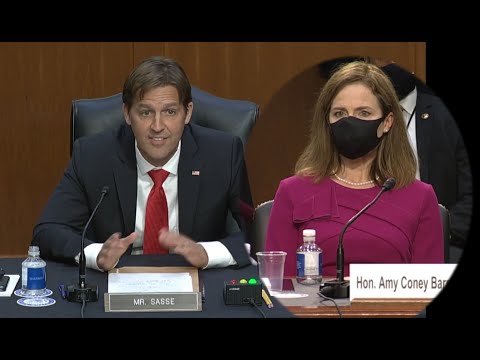
Sen. Ben Sasse: 8th Grade Civics 101 Opening Statement in Barrett Supreme Court Confirmation Hearing
On October 12, 2020, during the opening day of Judge Amy Coney Barrett’s Supreme Court confirmation hearing, Senator Ben Sasse (R-NE) delivered a notable opening statement that reframed the proceedings as an exercise in basic civics education. Sasse argued that much of the hearing had devolved into healthcare policy debates that belonged in the Finance Committee rather than the Judiciary Committee, and called on his colleagues to distinguish between “civics” — the foundational principles Americans share — and “politics” — the subordinate policy disagreements. His remarks centered on three concepts he said every eighth-grader should understand: religious liberty, the danger of judicial activism, and the threat of court packing.
Civics Versus Politics
Sasse opened by acknowledging Senator Klobuchar’s remarks about COVID-19 and even agreed with parts of her criticism of Washington’s pandemic response, but questioned the relevance to the confirmation hearing. “Huge parts of what we’re doing in this hearing would be really confusing to eighth graders if civics classes across the country tuned into this hearing and tried to figure out what we’re here to do,” he said.
He then laid out a framework distinguishing civics from politics. Civics, he argued, represents “the stuff we’re all supposed to agree on regardless of our policy views’ differences” — the foundational rules that do not change based on party affiliation. He defined civics as including principles such as Congress writing laws, the executive branch enforcing them, and courts applying them.
Politics, by contrast, was the “subordinate, less important stuff that we differ about.” He illustrated the distinction with a humorous exchange, imagining himself telling Senator Chris Coons, “Listen up jackwagon, what you want to do on this particular finance committee bill is going to be way too expensive and might bankrupt our kids” — and Coons responding in kind. That debate, he said, was legitimate politics, not civics.
“Civics doesn’t change every 18 to 24 months because the electoral winds change or because polling changes,” Sasse emphasized. “Politics is the legitimate stuff we fight about, and civics is the places where we pull back and say, ‘Wait a minute, we have things that are in common.’”
Religious Liberty as the Foundational American Principle
Sasse identified religious liberty as “the basic pre-governmental right” at the heart of American civics. He described it as the principle that “how you worship is none of the government’s business. Government can wage wars, government can write parking tickets, but government cannot save souls.”
He linked religious liberty to the five freedoms of the First Amendment — religion, speech, press, assembly, and protest — and argued these are all “basic pre-governmental rights” that exist before and above policy debates. “Contrary to the belief of some activists, religious liberty is not an exception,” he said. “You don’t need the government’s permission to have religious liberty. Religious liberty is the default assumption of our entire system.”
Sasse then directly addressed prior criticism of Barrett’s Catholic faith by committee members in previous proceedings. “This committee isn’t in the business of deciding whether the dogma lives too loudly within someone,” he said, referencing Senator Dianne Feinstein’s widely discussed 2017 remark during Barrett’s appellate court confirmation. “This committee isn’t in the business of deciding which religious beliefs are good, and which religious beliefs are bad, and which religious beliefs are weird.”
He leaned into the point with self-deprecating humor: “As somebody who’s self-consciously a Christian, we’ve got a whole bunch more, really weird beliefs. Forgiveness of sins, the virgin birth, resurrection from the dead, eternal life. There are a whole bunch of really, really crazy ideas that are a lot weirder than some Catholic moms giving each other advice about parenting.”
Rejecting Judicial Activism
Sasse defined judicial activism as the “really bad idea that tries to convince the American people to view the judiciary as a block of progressive votes and conservative votes, Republican justices and Democratic justices.” He described it as “the confused idea that the Supreme Court is just another arena for politics.”
He criticized politicians who try to get judicial nominees to pre-commit to outcomes on future cases, calling it a “violation of our oath to the constitution.” The proper approach, Sasse argued, was originalism — “basically the old idea from eighth grade civics that judges don’t get to make laws. Judges just apply them.”
Sasse described an originalist judge as someone who “comes to the Court with a fundamental humility and modesty about what the job is that they’re there to do” and does not view herself as “a super legislator whose opinions will be read by angels from stone tablets in heaven.”
He contrasted this with judicial activism, which he compared to judges wearing “red or blue partisan jerseys” under their black robes. “We should reject all such judges,” he said.
Warning Against Court Packing
The final concept Sasse addressed was court packing, which he called “a partisan suicide bombing that would end the deliberative structure of the United States Senate.” He defined it as the effort to “blow up our shared civics” by eliminating the Senate filibuster and adding seats to the Supreme Court to change its ideological composition.
Sasse pushed back against what he described as a media-friendly rebranding of the concept: “Court packing is not judicial reform, as some of you who wrote the memo over the weekend got a lot of media to bite on. Court packing is destroying the system we have now. It is not reforming the system we have now.”
He also took aim at politicians who had refused to answer whether they supported changing the number of justices, calling their silence a failure of transparency: “When they want to try to change the outcome of what courts do in the future by trying to change the size and composition of the court, that is a bad idea that politicizes the judiciary and reduces public trust.”
Sasse concluded that “the American people actually want a Washington DC that depoliticizes more decisions, not politicizes more decisions.”
Key Takeaways
- Senator Sasse reframed the Barrett confirmation hearing as a civics lesson, distinguishing between “civics” — the foundational principles all Americans share, such as separation of powers and religious liberty — and “politics” — the subordinate policy disagreements that belong in legislative committees.
- He defended religious liberty as the “default assumption” of the American system and directly challenged prior committee scrutiny of Barrett’s Catholic faith, declaring that evaluating nominees’ religious beliefs “is nuts” and “a violation of our basic civics.”
- Sasse warned against both judicial activism and court packing, calling originalism the proper antidote to politicized courts and describing proposals to add justices as “a partisan suicide bombing” that would destroy the Senate’s deliberative structure.