 HYGO News
 Chicago Mayor Johnson Calls Trump 'A Monster': 'We Have a President Having Tantrums'; Reporter Asks 'Why Are You a Racist?' Johnson 'Rejects the Premise'; Cites Gomez Riverfront Restaurant License Yanked and Given to Black Restaurateur
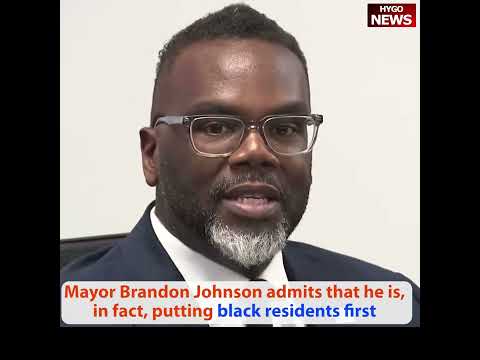
Chicago Mayor Johnson Calls Trump “A Monster”: “We Have a President Having Tantrums”; Reporter Asks “Why Are You a Racist?” Johnson “Rejects the Premise”; Cites Gomez Riverfront Restaurant License Yanked and Given to Black Restaurateur
Chicago Mayor Brandon Johnson’s May 2025 press conference produced several remarkable moments. Responding to the DOJ investigation of his racially-based hiring practices, Johnson attacked Trump: “He’s a monster. Period. We have the most diverse administration in the history of Chicago. And he is threatened by that. We can tell when someone is fearful is because they act out. We have a president that is screaming and having tantrums right now because we have an administration that reflects the city of Chicago, but he would much rather have administrations that reflect the country club.” Johnson proudly defended the racial hiring practice: “Every single dime that our people have been robbed of, I want to make sure that that is returned to threefold… Business and economic neighborhood development — Black woman. Planning and development — Black woman. Infrastructure — Black woman. Chief operations — Black man. Budget director — Black woman. Senior advisor — Black man.” When a reporter asked directly: “Why are you a racist?” Johnson responded: “I reject the premise that somehow that’s an actual legitimate question.” The reporter cited specific evidence: Robert Gomez’s riverfront restaurant license yanked and given to a Black restaurateur.
”He’s a Monster”
Johnson’s opening frame attacked Trump personally.
“You know, as far as, you know, the president’s animus towards women, people of color, working people, we have always known who he has been,” Johnson said. “This is not a surprise. He’s a monster. Period.”
He described his own administration: “We have the most diverse administration in the history of Chicago. And he is threatened by that.”
He offered psychological analysis: “We can tell when someone is fearful is because they act out. We have a president that is screaming and having tantrums right now because we have an administration that reflects the city of Chicago, but he would much rather have administrations that reflect the country club.”
The “monster” characterization was extreme political rhetoric. Describing any elected president as a “monster” — rather than as someone with different policies — represented a specific political framing. This characterization:
- Dehumanized a political opponent
- Justified any response regardless of proportion
- Shifted debate from policy to character
- Made negotiation or compromise impossible
- Represented broader Democratic political framing
Johnson’s “country club” framing was interesting. Trump had indeed built his career partly through golf clubs and luxury resorts, including Mar-a-Lago. But the implication that Trump’s administration reflected a “country club” demographic was at odds with actual appointment data. Trump’s second term cabinet included:
- Multiple Black cabinet members
- Multiple Hispanic senior officials
- Multiple Asian American officials
- Working-class backgrounds (including Hegseth’s military service, Patel’s FBI career)
- Non-traditional backgrounds (entertainment industry, tech, etc.)
The “country club” framing was political rhetoric rather than factual description. Trump’s administration was indeed ideologically conservative, but it was not demographically narrow.
”Bone of the Brunt”
Johnson invoked historical victimization framing.
“Why wouldn’t I speak to black Chicago? Why wouldn’t I?” Johnson asked.
He made the victimization claim: “Black Chicago and black people in America have borne the brunt of the type of policies in the maneuvering and the humiliating tactics that are coming from the federal government right now.”
He justified racial preferences: “It’s not a secret. Who is going to be mad at the fact that we have to prioritize spaces in the city that have been harmed the most?”
The factual claim that Black Americans had “borne the brunt” of Trump administration policies was disputable. Under Trump’s first term, Black unemployment had reached historic lows, criminal justice reform had been enacted (the First Step Act), and various specific initiatives had targeted historically disadvantaged communities. Under Trump’s second term, similar patterns had emerged.
The actual Trump policies Johnson was criticizing appeared to be:
- Immigration enforcement (affecting some Black immigrants but also Hispanic and other groups)
- DEI program eliminations (removing programs that had been designed for racial preferences)
- Educational policy changes (reducing federal involvement, not race-specific)
- DOJ investigations of municipal racial hiring (which directly affected Johnson’s own practices)
None of these constituted “bearing the brunt” specifically of anti-Black policies. But the framing allowed Johnson to position himself as champion of Black Chicagoans against a federal government characterized as hostile to them.
The O’Hare Prime Contract
Johnson defended the racial contracting practices.
“Prime construction contract at O’Hare under my administration is the first black prime construction company to have a prime contract anywhere in the United States of America,” Johnson said.
He extended the framing: “And that’s critical not just for Boa Construction, but for the lives that he’s going to transform because he’s hiring them.”
He described the broader impact: “But it’s also critical for other major construction companies or mid-sized construction companies that are black owned to know that there is a mayor who sees them and is going to work hard to ensure that whether you’re developing homes, whether you are looking to help take advantage of the opportunities through aviation, whether it’s entrepreneurship to provide a service, that there are resources available for you in the city of Chicago."
"Threefold”
Johnson made the most politically damaging specific commitment.
“And one thing that I know for sure that I have to do over these next two years, every single dime that our people have been robbed of, I want to make sure that that is returned to threefold.”
The “our people” and “threefold return” framing was problematic in multiple ways:
Racial particularism: “Our people” clearly referred to Black Chicagoans specifically, not all Chicagoans. The mayor of a multiracial city committing to serve one racial group specifically was inherently exclusionary.
“Robbed”: The framing characterized historical and current economic outcomes as theft. This was rhetorical rather than analytical; economic disparities had multiple causes, and characterizing them as theft made compensation an obligation rather than a policy choice.
“Threefold”: The commitment to threefold return — presumably meaning triple what had been “robbed” — went beyond compensation to explicit wealth transfer. If Black residents had experienced X dollars of economic disadvantage, Johnson was committing to provide 3X in compensation, paid by the rest of Chicago.
Constitutional concerns: Government programs providing racial preferences or racial transfers faced strict scrutiny under equal protection jurisprudence. Johnson’s explicit commitment to “threefold” return created obvious constitutional vulnerability.
The legal implications were significant. Chicago’s contracting and hiring practices would face likely federal investigation. The Department of Justice under Trump had made clear that racial discrimination in government hiring or contracting — regardless of which race was being preferred — would face aggressive enforcement.
Johnson’s “Not Hiring Only Blacks” Framing
Johnson tried to complicate his own framing.
“The contractors that will push back on me and say, you know, the only thing that the mayor talks about is the hiring of black people,” Johnson acknowledged.
He offered his rejoinder: “No, what I’m saying is when you hire our people, we always look out for everybody else.”
He returned to the “generous” framing: “We are the most generous people on the planet. I don’t know too many cultures that have play cousins. That’s how generous we are. We just make somebody a family member. Right? This is how we are.”
He then listed the cabinet positions: “Business and economic neighborhood development, the deputy mayor is a black woman. Department of planning and development is a black woman. Infrastructure deputy mayor is a black woman. Chief operations officer is a black man. Budget director is a black woman. Senior advisor is a black man.”
He made the rhetorical point: “And I’m laying that out because when you ask, how do we ensure that our people get a chance to grow their business?”
The internal contradiction in Johnson’s framing was apparent. He claimed not to hire “only black people,” but then proudly listed six senior cabinet positions, all held by Black officials. The claim that hiring only Black officials somehow helped “everybody else” through their generosity was not a legal defense against discrimination charges.
The Reporter’s Direct Question
A reporter asked the direct question that cut through the rhetoric.
“For over a year, real Chicagoans white and black have been telling me that your black power rhetoric is bringing the city backwards from a place that had overcome,” the reporter said.
She delivered the specific question: “What Chicagoans want to know? Why are you a racist?”
Johnson’s response was predictable: “Well, you know, first of all, I reject the idea and the premise that somehow that that’s an actual legitimate question.”
He refused to engage: “You want that? All right, we’re going to go to the next one.”
The reporter insisted on follow-up: “Alice. The next question, my follow up question is, is a businessman, Robert Gomez, had his river front restaurant license yanked.”
The Gomez Case
The reporter cited specific evidence.
“You said that the reason you hire black people is because they’re the most generous race on the planet,” the reporter said. “His river front restaurant license was yanked and given to a black restaurateur that has, once again, reinforced the belief among real Chicagoans that you are a racist.”
“What do you say to those people?”
Johnson: “Again, I reject the premise that somehow that your question has any legitimacy. Thank you for your time.”
The Gomez case was specific and damaging. Robert Gomez had operated a riverfront restaurant under city license. The city had revoked his license and then granted it to a Black restaurateur. If these facts were accurate — and Johnson did not dispute them — then:
- A Hispanic businessman had lost his livelihood
- A Black businessman had received the opportunity transferred from the Hispanic owner
- This occurred under an administration openly preferencing Black-owned businesses
This was exactly the kind of specific, documented, damaging case that made Johnson’s general framing untenable. He could talk about “our people” being “robbed” and receiving “threefold return” in abstract terms. But when a specific Hispanic business owner had been visibly harmed in a specific transfer to a Black business owner, the racial preferences became concrete and legally problematic.
The “reject the premise” response was Johnson’s standard deflection. Rather than explaining what had happened to Gomez, what legal justification existed for the license transfer, or how this fit his general racial equity framework, Johnson simply refused to answer.
”Reject the Premise” as Political Strategy
Johnson’s repeated use of “reject the premise” reflected a specific political strategy. Rather than:
- Defending specific actions on their merits
- Acknowledging problematic cases and explaining them
- Offering policy rationales that could be evaluated
- Engaging with the actual substance of criticism
Johnson was refusing to engage with questions that he could not comfortably answer. The “reject the premise” response:
- Avoided admitting problematic facts
- Characterized critics as illegitimate rather than wrong
- Preserved his political positioning
- Left the underlying questions unanswered
This approach was politically survivable in the short term — Johnson had a base that supported him regardless. But it made substantive governance impossible. A mayor who could not answer specific questions about specific decisions was not accountable in any meaningful sense.
The political damage would compound over time. Each specific case that Johnson could not explain — Gomez’s restaurant, the O’Hare contract, the cabinet racial composition, the “threefold return” commitment — would accumulate. Eventually, the federal investigations that Johnson’s “monster” rhetoric was meant to delegitimize would find documentary evidence of systematic racial discrimination that would be legally indefensible.
Key Takeaways
- Johnson calls Trump “A monster. Period” over DOJ investigation of Chicago racial hiring practices.
- Johnson defends explicit racial hiring: “Every single dime our people have been robbed of — returned threefold.”
- Johnson lists six senior cabinet positions, all Black — defends as “most diverse in history of Chicago.”
- Reporter asks directly: “Why are you a racist?” Johnson: “I reject the premise.”
- Robert Gomez’s riverfront restaurant license yanked, given to a Black restaurateur — concrete case Johnson won’t address.