 HYGO News
 Chicago Mayor Johnson Admits Racial Hiring: 'We Are the Most Generous People on the Planet'; Rep. Summer Lee: Black Millionaires Qualify Too, No Slave Ancestry Needed; Pressley: 'We Need Reparations NOW'
Chicago Mayor Johnson Admits Racial Hiring: “We Are the Most Generous People on the Planet”; Rep. Summer Lee: Black Millionaires Qualify Too, No Slave Ancestry Needed; Pressley: “We Need Reparations NOW”
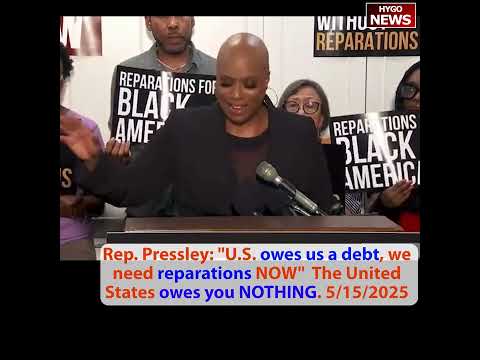
Multiple May 2025 statements from Democratic officials converged on race-based policy in unusually explicit terms. Chicago Mayor Brandon Johnson acknowledged systematic racial hiring preferences: “When you hire our people, we always look out for everybody else. We are the most generous people on the planet. I don’t know too many cultures that have play cousins.” He listed senior cabinet positions: “Business and economic neighborhood development — Black woman. Planning development — Black woman. Infrastructure — Black woman. Chief operations — Black man. Budget director — Black woman. Senior advisor — Black man.” Rep. Summer Lee (D-PA) clarified the reparations bill’s scope: “Whether or not a Black American were able to break into the middle class, they are not excluded. Lineage tracing is a distraction tactic.” Rep. Ayanna Pressley pushed: “The United States government owes us a debt. The antidote to anti-blackness is to be pro-black.”
Johnson: “We Are the Most Generous”
The Chicago Mayor’s remarks came in response to criticism of his administration’s hiring patterns.
“Some detractors will push back on me and say, you know, the only thing that the mayor talks about is the hiring of Black people,” Johnson acknowledged.
He gave his defense: “No, what I’m saying is, when you hire our people, we always look out for everybody else. We are the most generous people on the planet.”
He offered a cultural example: “I don’t know too many cultures that have play cousins. That’s how generous we are. We just make somebody a family member, right? This is how we are.”
The “play cousins” reference was to the African-American cultural practice of extending family relationships to close friends, often through fictive kinship that treats non-biological relatives as family members. Johnson was using this cultural practice as evidence that Black Americans were uniquely generous and inclusive in their approach to community.
The factual basis of the “most generous people on the planet” claim was contestable. Charitable giving data, including both monetary donations and volunteer hours, shows varying patterns across demographic groups. No reliable data supports the claim that any racial or ethnic group is uniquely “the most generous” — generosity patterns vary by income, religious affiliation, age, and other factors rather than by race.
The Senior Cabinet Listing
Johnson then provided what he apparently intended as supportive detail.
“Business and economic neighborhood development, the deputy mayor is a Black woman,” Johnson said.
He continued through the list: “Department of planning development is a Black woman. Infrastructure, deputy mayor is a Black woman. Chief operations officer is a Black man. Budget director is a Black woman. Senior advisor is a Black man.”
He explained the pattern: “And I’m laying that out because when you ask how do we ensure that our people get a chance to grow their business.”
The complete racial uniformity of the senior cabinet listing was striking. Johnson named six senior positions, all filled by Black officials. This was not a diverse cabinet with representative Black inclusion. It was a Black cabinet.
The legal and ethical concerns raised by such a hiring pattern were significant:
Equal Protection: The Fourteenth Amendment’s Equal Protection Clause prohibits racial discrimination by government officials. Systematically preferring one racial group over others in hiring could constitute illegal discrimination, regardless of whether the preferred group had been historically disadvantaged.
Title VII: The Civil Rights Act of 1964 prohibits employment discrimination on the basis of race. This applies to government employers as well as private ones. Intentionally selecting only Black candidates for senior positions would likely violate Title VII.
Municipal Code: Chicago’s own municipal code includes anti-discrimination provisions for public employment. A mayor publicly acknowledging that senior hiring decisions were based on race would likely violate these provisions.
Performance Implications: Even setting aside legal issues, systematic selection for race rather than qualifications would tend to produce suboptimal outcomes. The best qualified candidate might not be selected because they were the wrong race; less qualified candidates would be preferred because they were the right race.
Johnson’s apparent lack of awareness about the legal and ethical problems with his statement was perhaps the most striking aspect. He seemed to believe that acknowledging systematic racial preference in hiring was appropriate rather than problematic.
The Racial Justice Framework
Johnson stated the broader framing:
“We are in a moment of anti-blackness on steroids and we refuse to be silent. We will not back down in our pursuit of racial justice. The antidote to anti-blackness is to be pro-black and we will do it unapologetically.”
This framing — “pro-black” as the response to “anti-blackness” — was the ideological basis for Johnson’s hiring approach. Rather than treating race as irrelevant to government hiring (the colorblind ideal of traditional civil rights law), Johnson was explicitly endorsing race-based preferences as a response to perceived racial injustice.
Critics of this framework argued several points:
Constitutional concerns: The Constitution guaranteed equal protection under the law, not equal outcomes based on race. “Pro-black” policy by definition treated people differently based on race, which was what civil rights law was designed to prevent.
Historical inversion: The language of “pro-black” policies inverted the historical civil rights framework. Where Martin Luther King Jr. had called for judgment by “the content of their character” rather than “the color of their skin,” the “pro-black” framework explicitly used skin color as a primary consideration.
Practical consequences: Race-based preferences, even when intended as remedies for past discrimination, could generate new resentments, weaken institutional legitimacy, and produce suboptimal outcomes when the preferred candidates were not the best qualified.
Summer Lee: “Lineage Tracing Is a Distraction”
Rep. Summer Lee (D-PA) addressed the reparations bill’s scope.
Asked about the resolution’s aims: “Is it that Black Americans of a certain economic level are they being targeted? Is it everyone?”
Lee clarified: “So basically it doesn’t matter as to what economic level. It’s pretty much all Black Americans.”
Asked about eligibility requirements: “What about those individuals on any race that have a lineage going back to slave America?”
Lee responded: “It doesn’t matter. So to be very clear, whether or not a Black American, a Black descendant of American title slavery were able to break into the middle class, they are still — they were able to do that despite the harms, despite the passing justices done to them so they are not excluded from the reparation and the remedies they’re in.”
On whether lineage mattered at all: “When we think about who traces their lineage back, that is again a debate that is used to try to silence the rest of this movement. It’s a distraction tactic because what we want to do is instead of focusing on again what the system did, who did it, and what the impact of it was, we rather get bogged down and well should they make $25 an hour or should they be paid below a living wage, right? Should they have been educated or if they were educated, are they qualified? No, they are black.”
Lee’s position represented the maximalist position on reparations eligibility. Her key concessions:
Wealth irrelevance: Black millionaires would qualify for reparations equally with low-income Black Americans. The rationale was that their success had occurred “despite the harms,” so they remained eligible.
Lineage irrelevance: Black Americans did not need to trace their ancestry to American chattel slavery. Recent immigrants from Africa or the Caribbean would qualify equally with descendants of slaves.
Simple criterion: “No, they are Black. If they are Black and they are descendants of slaves, then they were directly in the lineage of harm. If they are descendants of Jim Crow, Jim Crow policies in this country, they are the direct descendants and current living recipients of that harm.”
The maximalist eligibility criteria raised practical problems. If Black millionaires qualified equally with poor Black Americans, reparations would not be functioning as wealth redistribution. If recent immigrants qualified equally with descendants of slaves, reparations would not be functioning as compensation for specific historical injustices. The resulting program would be pure racial transfer: money from non-Black Americans to all Black Americans, without regard to actual experience of harm.
The Harms Still Occurring
Lee described current ongoing harms:
“If they are living today, then we are still harmed by inequitable funding schemes of public schools.”
She listed environmental concerns: “We are still harmed by being black or brown or poor and living nearer to environmental hazards all over this country.”
She cited financial services: “If you are black in this country right now, you are still less likely to be able to acquire a loan. The interest rates are still higher for black folks who are attempting to buy homes or go to school.”
She named workplace discrimination: “We are still discriminated because of our hair, because of our names, when we go to get jobs.”
These specific claims had varying factual support:
School funding: School funding disparities did exist in American education, but they correlated more strongly with property wealth than race directly. Wealthy Black neighborhoods had well-funded schools; poor white neighborhoods had underfunded schools.
Environmental hazards: Environmental justice research had documented correlations between minority neighborhoods and environmental hazards, though whether this reflected direct racial targeting or broader socioeconomic patterns was debated.
Lending discrimination: Fair lending data did show some disparities in loan approval rates and interest rates, though the extent to which these reflected racial discrimination versus credit history differences was contested.
Hiring discrimination: Studies using identical résumés with different names had found some discrimination effects, though the magnitude and current relevance were debated.
Pressley’s “Debt” Framing
Rep. Ayanna Pressley (D-MA) closed with the reparations framing.
“We are in a moment of anti-blackness on steroids and we refuse to be silent,” Pressley said. “We will not back down in our pursuit of racial justice.”
She gave the core framing: “The antidote to anti-blackness is to be pro-black and we will do it unapologetically.”
She made the demand: “The United States government owes us a debt, and we need reparations. No. A duty to repair. So let’s make it clear. There is a debt that does exist.”
She laid out the historical basis: “This country has taken so much from black folks and has a debt it owes because for over 400 years into this very day this country has stolen black labor, black lives, black futures.”
The “debt” framing was rhetorically powerful but legally problematic. Debts are enforceable obligations between specific parties. A debt is owed by someone to someone, for specific consideration. The “debt” that Pressley claimed the U.S. government owed was:
- Owed by whom? Current American taxpayers, most of whom had no ancestors involved in slavery
- Owed to whom? All Black Americans, including recent immigrants and those with no slave ancestry
- For what specific consideration? Historical wrongs done by previous generations
These ambiguities were why reparations proposals consistently failed to generate consensus even within progressive coalitions. The specifics of who owed what to whom, and for what precisely, required answers that no framework had satisfactorily provided.
Key Takeaways
- Chicago Mayor Johnson admits systematic racial hiring: “When you hire our people, we always look out for everybody else. Most generous people on planet.”
- Johnson’s senior cabinet: six positions listed, all Black — legal and ethical concerns ignored.
- Rep. Summer Lee: Black millionaires qualify for reparations equally. Lineage tracing “a distraction tactic.”
- Rep. Pressley: “Antidote to anti-blackness is to be pro-black. We will do it unapologetically. US owes us a debt.”
- Maximalist eligibility criteria create practical problems: not wealth redistribution, not historical compensation — pure racial transfer.