 HYGO News
 Chicago Mayor Johnson race-based grants to blacks, reparations; Dem Clarke: GOPs white supremacists
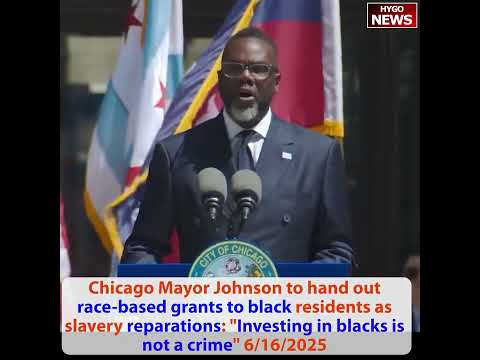
Chicago Mayor Johnson race-based grants to blacks, reparations; Dem Clarke: GOPs white supremacists
A single news cycle produced three distinct political moments that, together, illustrate the breadth of what Americans are being asked to accept, reject, or judge. Chicago Mayor Brandon Johnson announced a reparations-style program that would distribute race-based grants to Black residents — a program he defended with the phrase “investing in blacks is not a criminal act.” Representative Yvette Clarke called Republicans “white supremacists” whose “violence” and “cruelty” are designed to distract from their agenda. Clarke also boasted at a townhall about the 50-plus congressional letters she had signed on behalf of noncitizens and illegal aliens. Meanwhile, the administration announced the “Trump Account” — a $1,000 one-time contribution to an investment account for every American child born between 2025 and 2029. And Transportation Secretary Sean Duffy laid out the administration’s plan for modernizing the air traffic control system. The three threads reveal a political landscape in which Democrats are doubling down on race-based programs and immigration advocacy while Republicans are focusing on broadly accessible investment accounts for American families.
The Chicago Reparations Announcement
Mayor Johnson’s announcement came during a Juneteenth event. “Our way will bring to black residents in reclaiming ownership of our own communities. That is the spirit of Juneteenth, you all. It is about reflecting on our past. Other cultures are taught to never forget. We need to be reminded as blacks here in Chicago and America.”
The framing explicitly tied the grants program to the memorial work of Juneteenth. Juneteenth commemorates the emancipation of enslaved African Americans in Texas in 1865 — the moment when news of the Emancipation Proclamation reached the last enslaved population in the former Confederacy. Johnson’s argument is that commemorating that history requires material investment in the contemporary descendants.
“Remembering our past and working towards a more just future, investing in black, is not a criminal act. Sister Zakiya says she needs a witness, so I’m going to say it again. Investing in black is not a criminal act.”
The Legal Problem
The phrase “investing in black is not a criminal act” is the defense Johnson is preemptively offering against what he anticipates will be a legal challenge to a race-based grant program. Under the Supreme Court’s Students for Fair Admissions decision in 2023, race-based programs are subject to strict scrutiny and are presumptively unconstitutional unless narrowly tailored to serve a compelling government interest.
Johnson’s program — which he describes as directing money to Black residents specifically — would almost certainly face legal challenge on equal protection grounds. His framing that “investing in black is not a criminal act” is a political defense, not a legal one. It does not address the question of whether race-based distribution by a municipal government is constitutional. It only asserts that the distribution is morally justified.
The Inevitable Litigation
Any Chicago resident who is not Black and who pays taxes that fund the grants would have standing to challenge the program. Groups that have successfully challenged similar programs in other jurisdictions — including Students for Fair Admissions, the Pacific Legal Foundation, and various civil rights organizations — would likely bring suit. The litigation would test whether the program is narrowly tailored, whether its stated purpose qualifies as a compelling interest, and whether race-neutral alternatives could achieve the same goal.
The political bet Johnson is making is that announcing the program is the political win regardless of whether the program ultimately survives litigation. The announcement signals to his base that he is committed to reparative measures. The eventual court ruling will take years. By the time it arrives, the political moment the announcement was designed to capture will have passed.
Clarke: “Real Bandits”
Representative Yvette Clarke’s characterization of the Republican Party was unusually sharp. “And so we are up against some really, some real bandits here. They will use violence, they’ll use cruelty, they’ll use everything they can to distract from what their real motive is.”
“Real bandits” is the opening frame. The connotation is of a gang of criminals, not a governing coalition. That framing is a deliberate delegitimization. Parties that are called “bandits” are not parties with whom compromise is possible. They are parties that must be defeated.
”A Crowd Of White Supremacists”
Clarke’s most incendiary line was the characterization that dominates the clip. “But as we know, you know, litigation is not as nimble as an executive order and a crowd of white supremacists that are intending on moving forward with their agenda.”
“A crowd of white supremacists” is the description Clarke is applying to the current administration and its supporters. The charge is both specific and broad — specific in naming a particular ideology, broad in applying it to an entire political movement.
The charge is also, in the administration’s view, extremely difficult to defend on the evidence. The administration has senior officials and cabinet members across racial and ethnic backgrounds. The administration’s Hispanic support in 2024 reached historic highs. The administration’s Black support grew significantly from 2020 to 2024. Labeling this coalition “white supremacists” is, in the administration’s framing, a refusal to engage with the actual composition of the current Republican electoral coalition.
The 50-Plus Letters Boast
Clarke’s own accounting of her immigration advocacy was a sharper political moment than she may have intended. “Since January, I have led and signed 50 plus congressional letters on immigration to the administration addressing the following range of issues. Maintaining and extending, re-designating TPS for Haiti, Venezuela, and other countries. I’ve written letters on the wrongful deportations oversight of DHS detention facilities, opposing family detention, alarming enforcement actions at immigration courts, Trump, the Trump travel ban 2.0, and the economic impact of the of immigration related executive orders.”
Fifty-plus letters in six months is a remarkable output. Each letter represents time, staff work, and congressional attention. Clarke is rightly proud of the volume. But the subject matter — all of it related to the interests of noncitizens, undocumented individuals, and immigration enforcement targets — is the part that will produce political questions.
Who Is Clarke Representing?
The townhall was, in Clarke’s own framing, an event to speak with “the American citizens she represents.” The boast about 50-plus letters on immigration matters is therefore, in the administration’s framing, a revealing mismatch. The citizens she represents in Brooklyn are paying for the federal government that she is asking to extend protections to noncitizens. She is not, in her own accounting, producing an equivalent volume of letters on issues that affect her citizens directly — housing, wages, schools, public safety.
The charge is not that immigration advocacy is illegitimate. Representatives are entitled to pursue the policy priorities they view as important. The charge is that Clarke’s priorities, measured by her own accounting, are disproportionately focused on noncitizens at the expense of the citizens in her district.
”ICE In New York Is ‘Unacceptable’”
Clarke’s position on federal immigration enforcement in New York was captured in an adjacent clip. “I share the very deep concerns of my fellow Brooklynites, especially those who are fearful in our vibrant Caribbean community regarding the presence of ICE in our neighborhoods, schools, courts, and even Rikers Island. This is unacceptable and fundamentally contradicts the values that we hold as a sanctuary city.”
The phrase “unacceptable” is worth pause. ICE is the federal agency legally authorized to enforce federal immigration law. Its presence in American cities is not, in any constitutional sense, subject to local veto. Clarke’s use of “unacceptable” is a political signal, not a legal assessment.
The Trump Account
The administration’s counter-narrative on family policy is the “Trump Account.” “The latest plan in Washington to support families with young children, the Trump Account. It would give every American born between this year and January of 2029 a one-time $1,000 contribution to an investment account tracking a stock index. When the child turns 18, he or she could use the money in the account for education to start a business or buy a home.”
The policy is universal by design. Every American child born in the specified window — roughly four cohorts of births — receives the contribution. There is no means test. There is no racial test. There is no geographic test. The program is designed to be broadly accessible and politically durable.
The Investment Mechanism
The choice of an investment account tracking a stock index is the mechanism that distinguishes the Trump Account from the myriad earlier proposals for baby bonds or child savings programs. By investing in a broad stock index, the account grows with the American economy over the 18-year horizon. A $1,000 initial contribution, compounded at historical stock market returns, would grow to roughly $4,000-$8,000 by the child’s 18th birthday depending on market performance.
That amount is not life-changing in absolute terms, but it is meaningful. It is the down payment on college, the seed capital for a small business, or the first chunk of a home down payment. It arrives at exactly the age when young Americans face their first major financial decisions.
”Supports Life And Families And Prosperity”
The administration’s framing of the account was expansive. “Republicans are proud to be the party. We always have been. It supports life and families and prosperity and opportunity. And Trump accounts are all about setting up the next generation for success.”
The language — life, families, prosperity, opportunity — is the conservative quartet. The Trump Account is positioned as the material expression of the abstract values the Republican Party has traditionally claimed. The policy is the bridge between rhetoric and delivery.
The ATC Modernization
The video’s final thread was Transportation Secretary Sean Duffy’s briefing on air traffic control. “The system is absolutely safe. We have multiple redundancies in place as we drive the safest skies in the world in America. But again, that doesn’t mean we don’t have to upgrade.”
The framing is calibrated. The system is safe today. The system will not remain safe forever without investment. The administration is asking Congress to fund the upgrades before the underlying systems become a reliability problem.
”No Technology. We Need Technology Now”
Duffy’s operational diagnosis was blunt. “We don’t have some warning signs that your system is old. You use no technology. We need technology now that we have to use. Again, I hope the Congress is going to work with us to build out our plan.”
The transcription is choppy, but the argument is clear. The current air traffic control infrastructure relies on systems that are, in many cases, decades old. The FAA has been attempting to modernize through the NextGen program for years with mixed results. Duffy is asking Congress to fund a fresh approach — the air traffic control modernization plan that is embedded in the One Big Beautiful Bill.
The Political Contrast
The three threads of this video illustrate the contrast between the two parties’ current postures. Chicago’s mayor is announcing race-based grants. A Brooklyn representative is boasting about her advocacy for noncitizens. The Trump administration, meanwhile, is rolling out a universal $1,000 investment account for every American child and asking Congress to modernize the air traffic control system.
The contrast is not subtle. Voters who are watching the two postures are being asked to decide which approach they prefer. Universal benefits to American children, and modernized infrastructure — or race-based grants, advocacy for noncitizens, and rhetorical attacks on fellow Americans as “white supremacists.” The administration is betting that the contrast will resonate.
Key Takeaways
- Chicago Mayor Johnson on reparations grants: “Investing in black, is not a criminal act” — a pre-emptive defense against the legal challenge the race-based program will likely face.
- Rep. Yvette Clarke on Republicans: “real bandits…a crowd of white supremacists that are intending on moving forward with their agenda.”
- Clarke’s immigration record: “Since January, I have led and signed 50 plus congressional letters on immigration” — all focused on noncitizen interests.
- Trump Account: “every American born between this year and January of 2029 a one-time $1,000 contribution to an investment account tracking a stock index” — for “education to start a business or buy a home” at age 18.
- Sec. Duffy on ATC modernization: “The system is absolutely safe…but that doesn’t mean we don’t have to upgrade. We don’t have some warning signs that your system is old. You use no technology. We need technology now.”