 HYGO News
 Chicago Mayor: Trump intimidated by intellectual prowess of blacks; JB Pritzker stop apologizing
Chicago Mayor: Trump intimidated by intellectual prowess of blacks; JB Pritzker stop apologizing
Four connected story threads illustrating Democratic rhetorical and strategic posture. Chicago Mayor Brandon Johnson claiming Trump is “intimidated by the intellectual prowess of black men.” CNN’s Margaret Hoover ignoring DC crime evidence to worry about Trump “normalizing” federal crime intervention. Illinois Gov. JB Pritzker declaring Democrats “not wrong” and should “stop apologizing” for unpopular positions on defunding police and transgender athletes in girls’ sports. Rep. Suhas Subramanyam comparing Virginia’s Abigail Spanberger and NJ’s Mikie Sherrill to socialist Zohran Mamdani as “the future of the party.” Johnson: “The president has always been intimidated by the intellectual prowess of black men.” Hoover: “He’s normalizing this for American eyes and ears and making it seem like, oh, look, there’s a crime problem. We’ll just send the military because there is a slippery slope problem.” Pritzker: “Our values are exactly where they ought to be. So it’s time to stop apologizing when we’re not wrong.” Subramanyam on Spanberger: “She has both the charisma of someone like Mom Donnie, but also a really good ear to the ground."
"Intimidated by the Intellectual Prowess of Blacks”
Chicago Mayor Brandon Johnson’s claim. “If I, since you are begging, I do believe that Donald Trump is intimidated … So I would just say it like this, that the president has always been intimidated by the intellectual prowess of black men.”
That is the specific framing. Trump is intimidated. Specifically by “the intellectual prowess of black men.” The implication: Trump’s engagement with Black men — in politics, in business, in public discourse — is not principled disagreement but racial intimidation.
The factual basis is absent. Trump has worked extensively with Black political figures (Ben Carson, Scott Turner, Tim Scott during his time as Senator, various others). Trump has developed close relationships with Black entertainers, businesspeople, and faith leaders. Trump won significant Black male support in 2024 compared to any Republican in decades. None of that is consistent with “intimidated by intellectual prowess.”
Johnson’s specific position as Chicago mayor complicates the claim. Chicago under Johnson has experienced continued crime challenges, fiscal pressure, and governance disputes. Johnson’s approval ratings have been among the lowest of any Chicago mayor in recent history. The intellectual prowess framing sits uncomfortably alongside the city’s operational performance.
”People Feel Safer”
“And so, of course, he would speak in those petite and pure-wild terms because people feel safer. People just feel safer.”
That transcription is fragmentary, but the likely meaning is: Johnson suggests Trump uses specific rhetorical terms (Whisper’s “petite and pure-wild” is likely mishearing of some combination of “derogatory” or “racial” or similar terms) to make white audiences feel safer.
The argument: Trump’s rhetoric about crime, specifically in the context of majority-Black cities, produces a specific psychological effect for white voters. They “feel safer” when racial dynamics are framed in particular ways.
That framing assumes rather than demonstrates. It also projects specific motives onto Trump’s rhetoric without evidentiary support. Many voters — across racial lines — support federal crime intervention because they experience crime as a real problem, not because of racial psychology.
Hoover: “Slippery Slope” to Authoritarianism
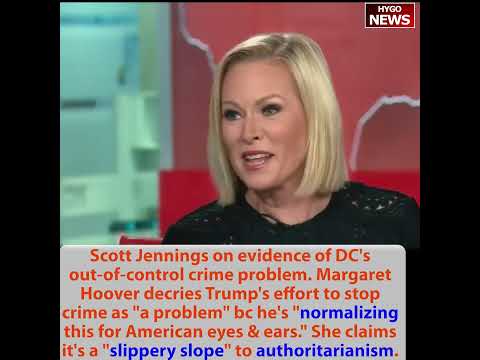
CNN’s Margaret Hoover on DC federalization. “I mean, the problem is, look, it’s a series, there’s, you and I both know it’s not that Washington and sending National Guard troops into Washington is legally permissible and it would be completely different if he had sent troops into New York City, for example. And the issue is that he’s normalizing this for American eyes and ears and making it seem like, oh, look, there’s a crime problem. We’ll just send the military because there is a slippery slope problem, Scott.”
The “slippery slope” framing. Hoover acknowledges DC deployment is legally permissible. But worries about normalization. If Americans accept National Guard deployment to DC, they may accept it in other cities where it would be less legally justified.
“Normalizing this for American eyes and ears” — Hoover’s specific concern. Not whether DC actually needs federal intervention. Not whether crime is real. The concern is media framing that makes federal intervention appear routine.
”Conservative Pedigree That Respects Jackson Balances”
“We come from a conservative pedigree that really respects Jackson Balances, that respects the military’s lane and civil society’s and police’s lane.”
“Jackson Balances” is Whisper’s rendering of “checks and balances.” Hoover’s claim is that conservatives traditionally respect separation-of-powers principles. Military should not be used for domestic law enforcement. Police handle civilian law enforcement. Civilian government oversees both.
That framework is generally correct. The Posse Comitatus Act restricts federal military involvement in domestic law enforcement. However, DC’s unique constitutional status (federal district, not state) creates exceptions that apply specifically to DC. Deploying National Guard to DC is legally different from deploying to a state.
Hoover is applying general principles without addressing DC’s specific legal situation. That allows her to treat the DC deployment as a slippery slope precedent — even though legally it is a specific case.
”Rudy Giuliani Turn a City Around”
“Like, we often watch Rudy Giuliani turn a city around. It would be amazing if someone could do it.”
Rudy Giuliani as Mayor of New York from 1994-2001. Dramatic reduction in crime during his tenure — murders dropped from 1,946 in 1993 to 649 in 2001. Property crime fell substantially. Quality-of-life issues (graffiti, public drinking, aggressive panhandling) addressed through broken-windows policing.
Hoover acknowledges Giuliani’s success. But she frames it as a local policing approach rather than federal intervention. The Giuliani model — NYPD transformation, local governance, broken-windows enforcement — is what cities can do. Federal intervention is a different question.
Scott Jennings (the conservative panelist Hoover is addressing) notes the problem. “All these cities in America, they can’t. It would be great. I agree. They can’t.” Cities like DC have not successfully implemented Giuliani-style transformation. They have had the opportunity. They have not succeeded.
“They can’t get it right in Chicago. They can’t get it right.”
Chicago under successive Democratic mayors has experienced sustained high violent crime. The city has had opportunities to implement Giuliani-style reforms. It has not done so successfully. The federal intervention conversation arises precisely because local governance has not produced public safety.
”Why Are You a Part of the Kline of the United States”
“Why are you a part of the Kline of the United States except for Donald Trump’s first term?”
That transcription is garbled. The likely meaning: Jennings is challenging Hoover on whether she supported Trump’s first term approach to cities. The structural question is whether conservatives who criticize Trump’s current approach supported equivalent approaches during the first term.
Pritzker: “Stop Apologizing When We’re Not Wrong”
Illinois Governor JB Pritzker’s messaging. “So the pundits and the critics about what direction the National Democratic Party needs to go, I say take a look at Illinois Democrats. Yes, winning elections is partly about messaging and strategy, but it’s mostly about values. And delivering on them. And our values are exactly where they ought to be. So it’s time to stop apologizing when we’re not wrong.”
That is a direct rejection of the post-2024 Democratic self-critique. After losing every battleground state in 2024, many Democrats argued the party needed to moderate on certain issues — defunding the police, transgender athletes in girls’ sports, open borders, etc. Pritzker rejects that framing.
“Our values are exactly where they ought to be.” Democratic values, as currently expressed, are correct. No moderation needed. No apology warranted.
“Stop apologizing when we’re not wrong.” The specific instruction. Democrats should not apologize for their positions. They should defend them. They should maintain them even when they appear to contribute to electoral losses.
That is the progressive-faction Democratic position. It rejects the moderation argument that comes from figures like James Carville, Rahm Emanuel, or centrist Democrats who argue the party’s positioning on cultural issues cost the 2024 election.
”They’re Paying Their Grocery Bills”
Pritzker continuing. “They’re paying their grocery bills. They’re going to the pharmacy. They’re paying for rent. They’re paying for mortgage. They’re paying to put gas in their automobiles. All of those costs have risen.”
That is Pritzker’s economic framing. Costs have risen. Americans are struggling with basic expenses. That claim is partially accurate — many costs did rise during 2021-2024. But the more recent data (which Pritzker is not addressing) shows costs falling in 2025 under Trump.
“Imagine now from an economic development standpoint, especially post COVID and everything and all the trauma that that caused along with global inflationary period that we’re living through now, they need this help.”
“Post COVID trauma” and “global inflationary period” as explanations for current economic conditions. Both framings distribute responsibility away from specific Democratic policy choices. The implication: Biden-era inflation was pandemic-caused rather than policy-caused.
The economic data does not fully support that framing. U.S. inflation during 2022-2024 exceeded many comparable nations. Fiscal policy choices (American Rescue Plan, etc.) contributed to inflation pressure. Monetary policy choices (Federal Reserve timing) contributed as well. The “global inflationary period” framing oversimplifies to the advantage of Democratic policy choices.
Spanberger and Sherrill: “Future of the Party”
Rep. Suhas Subramanyam on Virginia and New Jersey races. “What we need to look at is the elections in Virginia this November to see a great candidate. Abigail Spanberger is running for governor and she has both the charisma of someone like Mom Donnie, but also a really good ear to the ground and what people want because she’s had that has that lived experience.”
“Mom Donnie” is Whisper’s rendering of “Mamdani” — Zohran Mamdani, the Democratic socialist running for New York mayor. Subramanyam is comparing Spanberger, a centrist former CIA officer and three-term congresswoman, to Mamdani, a socialist state assemblyman.
That comparison is substantively problematic. Spanberger’s political profile — pragmatic, security-focused, relatively moderate on economic issues — is very different from Mamdani’s democratic socialist profile. The comparison implies Spanberger shares Mamdani’s charisma but with better political instincts.
Whether Spanberger would welcome the comparison is doubtful. Her political brand in Virginia has been carefully constructed to appeal to moderate voters in swing districts. Being characterized as Mamdani-adjacent potentially damages that brand.
“If you have more candidates like Spanberger and also in New Jersey, who have a great candidate for governor, I think that’s the future of the party there is people who both have the pragmatism and the ear to the ground on what voters want and need, as well as our charismatic, really appeal to people.”
Mikie Sherrill in New Jersey and Abigail Spanberger in Virginia as Subramanyam’s models for the Democratic future. Both are former national security professionals (Navy helicopter pilot and CIA case officer respectively). Both represent swing districts. Both have relatively centrist political profiles.
Key Democratic Strategic Tensions
The segment documents specific tensions within Democratic strategic thinking:
- Progressive: Pritzker’s “stop apologizing” posture
- Moderate-framing: Spanberger/Sherrill as “pragmatic” candidates
- Racial framing: Johnson’s “intellectual prowess” argument
- Anti-Trump framing: Hoover’s “slippery slope” concerns
Those approaches pull the party in different directions. Pritzker says maintain current positions. Moderate-framing suggests Spanberger/Sherrill’s pragmatism. Johnson’s racial framing alienates voters who want policy responses rather than racial interpretations. Hoover’s framing distances from DC crime concerns that ordinary voters share.
The tension explains why Democrats have struggled to develop a coherent post-2024 strategy. Different factions have different analyses. No unified message has emerged. The party is continuing to operate with multiple contradictory strategic frames.
Key Takeaways
- Chicago Mayor Brandon Johnson: “The president has always been intimidated by the intellectual prowess of black men” — framing policy differences as racial psychology.
- CNN’s Margaret Hoover on DC federalization: “He’s normalizing this for American eyes and ears and making it seem like, oh, look, there’s a crime problem. We’ll just send the military because there is a slippery slope problem.”
- Illinois Gov. JB Pritzker rejecting Democratic self-critique: “Our values are exactly where they ought to be. So it’s time to stop apologizing when we’re not wrong.”
- Pritzker framing Biden-era inflation as pandemic/global rather than policy: “Post COVID and everything and all the trauma that that caused along with global inflationary period that we’re living through now.”
- Rep. Suhas Subramanyam comparing Spanberger to Mamdani: “She has both the charisma of someone like Mom Donnie, but also a really good ear to the ground … I think that’s the future of the party.”