 HYGO News
 Cincinnati's Dem Mayor Hasn't Spoken to Victims; Kamala Harris dodges question on Biden's decline
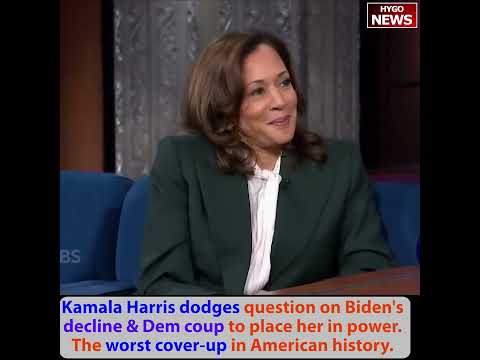
Cincinnati’s Dem Mayor Hasn’t Spoken to Victims; Kamala Harris dodges question on Biden’s decline
Four Democratic figures, four revealing moments. Cincinnati’s Democrat Mayor Aftab Pureval, asked whether he has met with victims of the Jazz Festival attack: “I have not … We have significant other public safety challenges.” Kamala Harris, asked when she was told to prepare for replacing Biden after the debate, deflected entirely by praising Biden’s “rule of law” values and ending the line of questioning. NY Governor Kathy Hochul defended Zohran Mamdani (who has called NYPD “racist and a threat to public safety”) against attacks from Elise Stefanik, characterizing the criticism as “about as pathetic as it gets.” And Rep. Ilhan Omar dismissed town hall constituents’ concerns about Democratic campaign tactics as “not an institutional problem … it takes numbers. In order for a message to go out."
"I Have Not”
The reporter’s question to Cincinnati Mayor Aftab Pureval. About meeting with victims of the Cincinnati Jazz Festival attack — the organized racial assault on White attendees that has been covered in multiple previous segments.
“I have not. I mean look again this was a fight. It was a horrific fight.”
“I have not” met with the victims. That is the direct admission. The mayor of the city where the attack occurred has not met with the Americans who were assaulted.
“It was a horrific fight” is Pureval’s characterization — using the same “fight” framing that Vice Mayor Kearney had used earlier. “Fight” implies mutual combat between equals. The footage showed organized group assault on individual victims. The mayor’s characterization conflates fundamentally different categories of incident.
“But as council member and others have said we have significant other public safety challenges. We have children. We have violent crime like every other major city across the nation that requires our attention and our bandwidth.”
That is the justification. Cincinnati has other public-safety priorities. The mayor’s time and attention must be distributed across those priorities. Meeting with victims of a specific racial attack is, by implication, not high enough priority to receive mayoral time.
”Not Traditionally Meet Every Victim”
“So I don’t traditionally meet or speak to every victim of violent crime in our city and that’s consistent with my approach today.”
“Not traditionally meet or speak to every victim of violent crime.” That is the broader posture. Pureval, as mayor, does not personally engage with individual crime victims. That is a policy choice.
The contrast with other mayors’ practice is instructive. Many American mayors do meet personally with victims of high-profile violent crimes — homicide victims’ families, mass-shooting victims, specific racial or ethnic attack victims. The meetings serve multiple purposes: comfort for the victims and their families, public signaling of mayoral concern, demonstration that the crime is taken seriously at the highest municipal level.
Pureval’s decision to categorically not engage with specific victims breaks with that practice. The specific political effect: the victims of the jazz festival attack receive no personal acknowledgment from the city’s chief executive. The attack’s status as a specific racial incident is, in effect, normalized as “violent crime” similar to all other violent crime.
“And that’s consistent with my approach today.” Pureval is defending his choice on process grounds. He does not meet with any victims. He did not meet with these victims. His consistency defends his choice. The underlying question — whether the approach is appropriate — is not engaged.
Kamala Harris on Biden
The reporter’s question to Harris. “When you saw Joe Biden walk on stage at that debate and it did not go well spoiler. It did not go well in that debate. Therefore you became the candidate. At what point in the say month that followed that did people start saying you might need to be prepared for this?”
That is a direct question. When did Harris first receive the signals that Biden would withdraw and she would become the candidate? That specific information — who told her, when, how — would document the coup against Biden from her perspective.
Harris’s answer. “Let me say something about Joe Biden. I have an incredible amount of respect for him. And I think that the way that we should be thinking about where we are right now is to remember that we had a president of the United States who believed in the rule of law. Who believed in the importance of aspiring to have integrity and to do the work on behalf of the people and that’s where I’ll leave that.”
That is the deflection. Harris answered a different question than the one asked. The reporter wanted specific timeline information about when Harris learned she would be the candidate. Harris answered with general praise for Biden’s values.
“Where I’ll leave that.” Harris explicitly closing the line of questioning. She is not going to engage with the specific “when were you told” question.
The implication: Harris either does not want to document the coup specifically, or the specific documentation is damaging enough that she would rather praise Biden’s values than describe the sequence of events that led to Biden’s replacement.
”Rule of Law” Deflection
“Had a president of the United States who believed in the rule of law. Who believed in the importance of aspiring to have integrity.”
That is the Harris framing of Biden. Rule-of-law believer. Integrity-aspiring. Values-driven executive.
The problem with that framing: the specific events under discussion — the rapid post-debate withdrawal and Harris’s elevation without a primary vote — do not reflect rule-of-law considerations. They reflect political calculations about electoral viability. Harris’s framing treats Biden as a values-focused institution, not a politician whose candidacy collapsed under empirical electoral pressure.
Hochul Defends Mamdani
The reporter’s question to Hochul. “Governor the shooting comes as you’re facing your own tough reelection campaign and Republican Congresswoman Elise Stefanik who could challenge you in that race posted to acts overnight saying we cannot allow radical anti-police dangerous policies to continue. And then she went on to attack the New York mayoral candidate Zoran Mamdani saying flashback Kathy Kokel’s very own comic Mamdani a disgrace and truly unfit to be mayor of New York City. The post June 2020 post from Mamdani calling to quote defund the police.”
That is the reporter laying out the Stefanik attack on Hochul for Mamdani support. Mamdani called for defunding the police in a June 2020 post. Stefanik is challenging Hochul to condemn Mamdani’s position.
Hochul’s response. “What do you say to Congresswoman Stefanik? That’s about as pathetic as it gets. I mean seriously going after an unelected official who said something back in 2020 when many people were. I mean come on give me a break.”
“An unelected official who said something back in 2020” is the Hochul minimization. Mamdani is the Democratic nominee for NYC mayor. He was an elected state assembly member at the time of the post. He is likely to become mayor of NYC given the partisan geography. Characterizing him as “an unelected official” minimizes his current political standing.
“When many people were” — when many people were calling to defund the police. That is factually correct. 2020 saw broad defund-the-police rhetoric across progressive circles. Many Democratic figures made similar statements during that period.
The framing problem: Mamdani has not walked back the position. Many other Democrats who used similar rhetoric in 2020 have subsequently distanced themselves. Mamdani has not. His 2020 position is not a youthful indiscretion abandoned on reflection. It is his current campaign position.
Ilhan Omar at Town Hall
The segment closed with a clip of Rep. Ilhan Omar at a town hall. “I’m not an institutional problem. I believe that because we collectively are impacted. I don’t when I work for office I don’t doorknob by myself. There are volunteers who come and help me do that.”
Omar is addressing a question about Democratic campaign tactics. The constituent’s question is not transcribed in full, but Omar is defending the practice of campaign volunteers doing door-knocking rather than candidates doing it personally.
“Where she gets to leave did in Michigan. She done doorknob the whole time by herself. For her initial campaign she was on the streets. I don’t have the national campaign I don’t have my campaigns now. I don’t have now instead of here.”
Omar comparing her situation to someone in Michigan (likely a specific candidate the constituent referenced) who does all her own door-knocking. Omar is defending the Democratic campaign infrastructure model — volunteers doing the legwork, candidates providing leadership and content.
“That’s not what I’m trying to say what I’m trying to say is it takes numbers. In order for a message to go out. That’s my move. Okay. Thank you that’s the right response.”
“Takes numbers” — campaign scale requires many volunteers. Omar is saying her campaign model relies on volunteers, not personal presence.
“Thank you that’s the right response.” That is Omar apparently dismissing the constituent and moving on. The constituent was making a specific point about campaign authenticity. Omar redirected to scale requirements and closed the exchange.
The Cumulative Pattern
Four Democratic figures, four revealing moments. Each pattern similar:
- Pureval: the mayor has not met with victims, because “I don’t traditionally meet every victim.”
- Harris: the reporter asked when she learned about the coup; she pivoted to Biden’s values.
- Hochul: Stefanik’s criticism of Mamdani is dismissed as “pathetic.”
- Omar: a constituent’s concern about campaign practices is dismissed as not Omar’s priority.
Each figure is deflecting from specific questions or concerns. Each is using general framing to avoid engaging with specific points. Each is exhibiting the kind of political positioning that frustrates ordinary voters who want direct answers.
The administration’s framing — aggregating these moments into single news cycles — is designed to make the pattern visible. Whether individual voters notice individual moments matters less than whether the pattern accumulates in their perceptions of Democratic Party responsiveness.
Key Takeaways
- Cincinnati Mayor Aftab Pureval has not met with victims of the Jazz Festival attack: “I don’t traditionally meet or speak to every victim of violent crime in our city.”
- Kamala Harris deflected when asked about the Biden post-debate replacement timeline, pivoting to Biden’s values: “We had a president of the United States who believed in the rule of law … that’s where I’ll leave that.”
- Rep. Elise Stefanik criticized Hochul for defending Mamdani: “Flashback Kathy Kokel’s very own comic Mamdani a disgrace and truly unfit to be mayor.”
- Gov. Kathy Hochul dismissed Stefanik as “about as pathetic as it gets. Going after an unelected official who said something back in 2020.”
- Rep. Ilhan Omar dismissed a constituent’s concerns at a town hall as “not an institutional problem … it takes numbers. In order for a message to go out.”