 HYGO News
 Dems vote 'hell no', strip citizenship, 400 amendments to delay, Raskin smugly creates 'PREAMBLE'
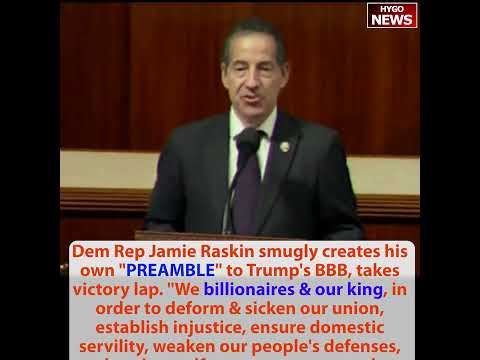
Dems vote “hell no”, strip citizenship, 400 amendments to delay, Raskin smugly creates “PREAMBLE”
House Democrats prepared their final offensive against the One Big Beautiful Bill as the House Republican leadership worked to secure final passage. Representative Jamie Raskin delivered one of the more theatrical moments of the legislative process — reading into the congressional record a mock “preamble” that parodied the preamble to the Constitution and recast the bill as a conspiracy by billionaires and the “king” to subjugate Americans. Representative Maxwell Frost detailed the specific procedural strategy: 400+ amendments forcing 5 minutes each of debate, designed to delay passage as long as possible. Representative Joaquin Castro characterized ICE funding as designed to “strip people of their citizenship.” And legal analyst Elie Mystal declared that the United States itself should be “sanctioned” by the international community for being “the bad guy on the world stage."
"Every House Democrat Will Vote Hell No”
The video opened with the declaration. “Every single house Democrat will vote hell no against this one big ugly bill.”
“Hell no” is the emphatic framing. Democratic leadership is not merely whipping votes against the bill — it is committing every Democrat to the emphatic rejection. Whether every Democrat actually votes as leadership directs will be revealed in the final vote count, but the public commitment is universal opposition.
The administration’s counter is that the Democratic opposition is opposition to specific benefits that voters broadly want. No tax on tips polls near 80% approval. No tax on overtime polls similarly well. Expanded child tax credits benefit 40 million American families. The Democratic caucus voting universally against those provisions creates specific political exposure for Democrats in competitive districts.
Castro On “Stripping Citizenship”
Representative Joaquin Castro of Texas offered a specific critique. “It will dedicate billions of dollars for them to go into Latino communities and try to strip people of their citizenship.”
The framing is striking. Castro is claiming that the bill’s ICE funding is designed to “strip people of their citizenship” rather than to enforce federal immigration law. The administration’s counter is direct: the ICE funding is for enforcement of federal immigration law against individuals who are deportable under existing statutes, not for attacks on citizenship rights of any population.
“Latino communities” is the specific geographic framing. Castro is suggesting that the enforcement will target Latino communities — which is accurate in the sense that Latinos represent a large proportion of undocumented individuals, but which is misleading if it implies the enforcement targets Latinos because of their ethnicity rather than because of their immigration status.
The Distinction That Matters
The distinction is important. Federal immigration enforcement operates without regard to ethnicity. ICE agents investigate individuals based on legal status, not national origin. Individuals in the United States legally — citizens, permanent residents, visa holders — face no risk from ICE enforcement regardless of their ethnicity.
Castro’s “stripping citizenship” framing implies something different. It implies that ICE is targeting citizens. That framing is not supported by the bill’s provisions or by the operational record of enforcement. Citizens are not deported. Citizens do not face citizenship revocation through ICE operations.
The specific category Castro may be referencing involves denaturalization proceedings — cases where federal authorities pursue revocation of citizenship for individuals who obtained it through fraud or material misrepresentation. Those proceedings exist in federal law but are rare and apply narrowly. They are not the primary focus of the bill’s ICE funding.
Raskin’s “Preamble”
Representative Jamie Raskin then delivered a theatrical moment. “We found the preamble to this big ugly bill. We the billionaires and our king in order to deform and sicken our union, establish injustice, ensure domestic servility, weaken our people’s defenses, undermine the general welfare and reserve to ourselves in our posterity, staggering debt servitude for eternity, do hereby instruct the Republicans in Congress…”
The mock preamble parodies the Constitution’s opening (“We the People of the United States, in Order to form a more perfect Union, establish Justice, insure domestic Tranquility, provide for the common defence, promote the general Welfare, and secure the Blessings of Liberty to ourselves and our Posterity, do ordain and establish this Constitution for the United States of America”).
Raskin’s inversions of each phrase — “We the billionaires and our king,” “deform and sicken our union,” “ensure domestic servility” — are meant as a rhetorical indictment of the bill. Each Constitutional phrase has a positive value that Raskin replaces with a negative value.
”Strip 17 Million Of Health Care”
Raskin’s preamble continued. “To strip 17 million people of their health care, increase co-pays, deductibles and premiums for everyone else, cut 42 million people off of nutritional assistance, increase the national debt by 4 trillion dollars, trash renewable energy systems, increase our electric bills for the carbon kings, all to weaken and destroy the Constitution of the people of these United States of America.”
The specific numbers are the Democratic critique in one compressed statement.
17 million losing health care — Trump’s own earlier statement had disputed this figure, claiming the actual number will be “very much smaller.”
Increased co-pays, deductibles, premiums for everyone — the framing is that Medicaid changes create cost pressures that ripple through the broader healthcare system. The causal mechanism is contested.
42 million off nutritional assistance — the SNAP reform figure. The administration’s counter is that the reforms target able-bodied adults without dependents, not the vulnerable populations SNAP was designed to serve.
$4 trillion debt increase — the CBO projected deficit increase. The administration’s counter is that dynamic scoring with 3% growth produces different results.
Trash renewable energy systems — the bill’s ending of IRA subsidies. The administration’s counter is that the subsidies were propping up specific technologies rather than producing genuine economic value.
Increase electric bills for carbon kings — the framing that bill provisions benefit fossil fuel producers at consumer expense. The administration’s counter is that American energy production, broadly construed, lowers consumer costs regardless of source.
”Please Include This Preamble In The Legislative Record”
Raskin closed with the procedural request. “Please include this preamble in the legislative record.”
The theatrical flourish serves multiple purposes. It produces a shareable moment that can be clipped and amplified. It demonstrates that Raskin is willing to use Senate/House floor time for theatrical rather than substantive purposes. And it ensures that his specific framing enters the congressional record, where it becomes part of the historical documentation of the debate.
Whether the theatrical approach actually persuades anyone is a separate question. Constitutional parody works as a rhetorical device for audiences predisposed to view the bill as Raskin characterizes it. For audiences who support the bill, the parody can reinforce the perception that Democratic opposition is performative rather than substantive.
Frost’s Procedural Strategy
Representative Maxwell Frost of Florida detailed the specific delay strategy. “So far we’ve introduced over 400 amendments. Each one of those amendments are going to give Democrats 5 minutes each to go and debate it.”
400 amendments × 5 minutes each equals 2,000 minutes of potential debate — roughly 33 hours if each amendment receives its full debate time. That is a substantial procedural delay.
“This last go around we’re able to delay the bill upwards of 30 hours and so we’re going to do the same thing.”
The precedent is important. Democrats had already demonstrated in the Senate that they could use procedural mechanisms to delay the bill by approximately 30 hours. The House strategy seeks to replicate that delay.
”The Longer This Bill Is In The Ether”
Frost’s theory. “Do everything we can from a procedural point of view to delay this. The longer this bill is in the ether the more unpopular it becomes.”
The theory is that prolonged debate benefits Democratic messaging. If the bill remains under public discussion for longer, the argument goes, more voters will learn about its provisions and will turn against it.
The counter-theory, which the administration has pushed, is that prolonged debate exposes voters to the specific provisions that are actually popular. No tax on tips, no tax on overtime, expanded child tax credits — each of these provisions, when voters learn about them specifically, generates approval. The longer the debate, the more voters learn about them, the more support the bill generates.
Which theory is correct depends on what information actually reaches voters during the extended debate. If Democrats succeed in framing the bill around the 17 million losing healthcare figure, the prolonged debate helps them. If Republicans succeed in framing the bill around the specific beneficial provisions, the prolonged debate helps them.
”The Largest Transfer Of Wealth”
Frost then offered the Democratic substantive framing. “It’s a very unpopular piece of legislation because it’s the largest transfer wealth from working class people and the working poor to billionaires and the ultra wealthy.”
The framing is the standard Democratic characterization. Whether it survives scrutiny depends on the specific distributional analysis. The bill’s tax cut provisions include substantial benefits for working-class households (no tax on tips, no tax on overtime, 15% rate cut for $30K-$80K earners). The bill’s spending reforms target waste and fraud rather than core benefits.
If the distributional analysis actually shows that working-class Americans benefit while the wealthy see limited benefit — which is the administration’s framing — then Frost’s characterization is empirically wrong. If the distributional analysis shows the opposite — which is Frost’s framing — then Frost’s characterization is empirically correct. Both sides claim the empirical facts support their framing.
”The Coalition Donald Trump Built”
Frost then pivoted to a political prediction. “And what this bill is also greatly dividing the coalition Donald Trump built during his campaign based off of a lie that he would help working people. But he’s doing what we knew he would do. He’s helping billionaires and the richest Americans.”
“The coalition Donald Trump built” is Frost’s acknowledgment that Trump assembled a genuine electoral coalition including substantial working-class support. “Greatly dividing” is Frost’s prediction that the bill will fracture that coalition.
The prediction’s accuracy depends on whether working-class Trump voters actually experience the bill as harming them. If the $5,000-$14,700 per family in take-home pay materializes, those voters will not feel harmed — they will feel benefited. Frost’s prediction requires the benefits to be illusory or less substantial than the administration claims.
”Hardest Working Folks…Lose Money”
Frost’s specific claim. “You’re talking about the hardest working folks. The folks who work paycheck to paycheck are actually going to lose money on this bill. Whereas the wealthiest Americans are going to just be making out like bandits.”
The claim is empirically testable. Working-class Americans will either see their paychecks increase or decrease following the bill’s implementation. If paychecks increase — as the administration’s framework predicts — Frost’s claim is wrong. If paychecks decrease, his claim is right.
The administration’s framework rests on specific provisions that increase take-home pay. Lower tax rates on the specific income brackets that working-class Americans occupy. No tax on tips for service workers. No tax on overtime for many working-class categories. Expanded child tax credit for families.
Whether those benefits outweigh any costs from other provisions (Medicaid changes, SNAP changes, etc.) depends on the specific household. Some households may net out worse; most, according to the administration’s analysis, net out better.
Elie Mystal: “Sanction Us”
The video then captured commentary from legal analyst Elie Mystal. “I don’t say this lightly but our country needs to be sanctioned. We are the bad guys on the world stage. We are a menace to not only free people everywhere but we are a menace to peaceful people everywhere at this point.”
The statement is extraordinary. Mystal is arguing that the international community should impose sanctions on the United States — the kind of economic penalty typically applied to rogue states, human rights abusers, or geopolitical aggressors.
”We Are The Bad Guys”
Mystal’s specific framing. “And I’m not even going to say that we’ve only been a menace for the past three or four months. When does the international community decide that enough is enough?”
“Three or four months” references the second Trump administration. Mystal is extending the critique back further — the United States has, in his framing, been “a menace” for longer than the current administration. But the current administration is, in his analysis, a more acute version of the pattern.
”We Should Be Sanctioned”
Mystal closed with the sanctioning call. “I know we’re rich. I know we’ve got a lot of money. I know that people want to buy things from our country because we’re rich or want to sell things to our country because we’re rich. But at some point the international community has to stand up to us because we are a bad guy on the world stage. And so we should be sanctioned. We should be sanctioned and rebuked.”
The argument is that America’s wealth and commercial importance have prevented the international community from imposing consequences on American behavior. Mystal’s call is for the international community to overcome that commercial deference and impose consequences regardless of the economic cost.
The administration’s counter to Mystal’s framing would be operational. The United States is pursuing peace — the DRC-Rwanda agreement, the Iran ceasefire, the India-Pakistan de-escalation. The United States is pursuing economic cooperation — NATO burden-sharing agreement, trade negotiations with multiple partners. The characterization of the United States as a “menace” is not supported by the administration’s actual engagement with the international community.
The Domestic Audience For Mystal’s Comments
Mystal’s statement is aimed primarily at domestic progressive audiences rather than at the international community. The international community will not actually sanction the United States — any sanctions regime would require broad international coordination that is not available. But progressive American audiences hear Mystal’s framing and receive validation for their hostile view of the current administration.
That validation is what makes Mystal’s statement politically significant. He is providing a vocabulary for extreme critique of the United States that progressive audiences can adopt and amplify. Whether they actually act on the sanctions framing is irrelevant — they absorb the vocabulary.
The Day’s Political Dynamic
The video captures the Democratic final push against the bill. Raskin delivers the theatrical preamble. Frost explains the procedural delay strategy. Castro frames the enforcement funding as citizenship-stripping. Mystal calls for international sanctions against the United States.
Each voice contributes to a coordinated Democratic messaging campaign. The campaign’s cumulative effect is designed to delegitimize the bill, to damage the administration politically, and to energize progressive supporters.
Whether the campaign succeeds depends on whether the bill’s specific provisions, once implemented, produce experiences that match Democratic framing or Republican framing. Voters who see their paychecks increase, their families receive child tax credits, and their daily lives become more affordable will discount the Democratic critique. Voters who do not see those benefits will find the Democratic critique validated.
Key Takeaways
- Rep. Jamie Raskin’s mock preamble: “We the billionaires and our king in order to deform and sicken our union, establish injustice, ensure domestic servility…”
- Rep. Joaquin Castro’s “strip citizenship” framing of ICE funding, which the administration characterizes as funding for routine immigration enforcement against deportable individuals.
- Rep. Maxwell Frost’s procedural strategy: “Over 400 amendments…5 minutes each to go and debate it…The longer this bill is in the ether the more unpopular it becomes.”
- Frost’s claim: “The folks who work paycheck to paycheck are actually going to lose money on this bill. Whereas the wealthiest Americans are going to just be making out like bandits.”
- Elie Mystal’s extreme framing: “Our country needs to be sanctioned. We are the bad guys on the world stage.”