 HYGO News
 Reporter to Schumer: 'Your Approval Is 17%' After He Cites Trump Polls; CNN's Enten: 'Democrats Can't Count Their Chickens'
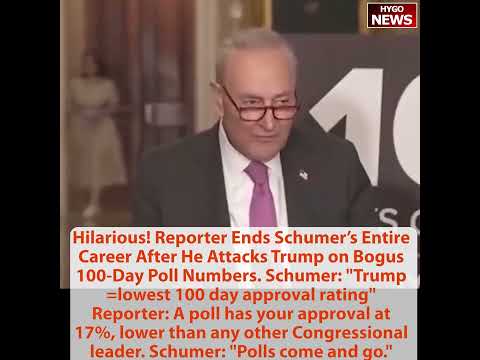
Reporter to Schumer: “Your Approval Is 17%” After He Cites Trump Polls; CNN’s Enten: “Democrats Can’t Count Their Chickens”
Sen. Chuck Schumer attempted to weaponize Trump’s 100-day poll numbers in May 2025 — and walked straight into a devastating counter-punch. Schumer declared: “The polls this week showed Trump has the lowest 100-day approval rating since they started polling 80 years ago.” A reporter immediately fired back: “There’s a poll out today that has your approval rating at 17%, lower than any other congressional leader. Are you concerned you may be a liability for your party?” Schumer’s response: “Polls come and go.” CNN’s Harry Enten then delivered the data that buried the Democratic narrative: “When you match Trump against his actual competition — congressional Democrats — Trump comes out ahead, 40% to 32%. Republicans crush Democrats on immigration by 19 points and lead on the economy by 9.”
Schumer’s Backfire
Schumer opened the press conference by citing what he thought was damaging data.
“The polls this week showed Trump has the lowest 100-day approval rating since they started polling 80 years ago,” Schumer said. “The lowest.”
A reporter turned the tables: “There’s a poll out today that has your approval rating lower than any other congressional leader at 17%. Are you concerned that you may be a liability for your party?”
Schumer’s response was instant deflection: “Polls come and go. Our party is united. We’re on our front foot. We’re stepping forward going after Trump and having real success.”
The exchange was a masterclass in political self-destruction. Schumer had entered the press conference armed with a poll number designed to embarrass Trump. Within seconds, a reporter had used the same polling methodology to expose that Schumer himself had an approval rating of 17% — a number so catastrophically low that it suggested most Americans didn’t know who he was or actively disapproved of him.
The “polls come and go” dismissal — offered seconds after citing a poll as definitive evidence — was the kind of hypocrisy that viral moments are made of. When polls showed Trump struggling, they were authoritative. When polls showed Schumer at 17%, they were fleeting. The double standard was so obvious that even sympathetic observers couldn’t defend it.
CNN’s Enten: “Democrats Can’t Count Their Chickens”
CNN data analyst Harry Enten provided the broader context that demolished the Democratic celebration.
“When you match Donald Trump against his actual competition, Donald Trump comes out ahead,” Enten said. “40% to congressional Democrats, 32%.”
He drew the circle: “When you look at Donald Trump in a vacuum, it’s one thing. But when you actually match him up against folks in the real world, all of a sudden his numbers look considerably better.”
He presented the party trust data: “Which party has a better plan? On immigration, the GOP crushes the Democrats — that’s a 19-point edge. You rarely ever see leads like that in politics these days.”
He continued: “On the economy, where Donald Trump’s numbers have been struggling a little bit, Republicans still hold a nine-point lead.”
He delivered the warning: “If Democrats think that just because Donald Trump is unpopular, they’re going to run away with it like a Heisman trophy winner, that is not necessarily the case.”
He stated the bottom line: “These numbers should be a major wake-up call for Democrats. Despite Donald Trump being unpopular in the polls, when you put Democrats’ names against him, when you put Republicans as a whole up against him, Republicans and Donald Trump do considerably better.”
He concluded: “At this point, the Democratic message ain’t selling a thing.”
The Enten analysis was devastating precisely because it came from CNN — the network most associated with anti-Trump coverage. When CNN’s own data analyst acknowledged that “the Democratic message ain’t selling a thing” and that Trump beat Democrats on every issue comparison, the Democratic celebration of Trump’s low approval numbers was exposed as hollow.
The Approval Rating Paradox
The 100-day approval rating discussion illustrated a fundamental paradox of Trump-era politics. Trump’s overall approval numbers were consistently lower than his issue-by-issue numbers. Americans told pollsters they disapproved of Trump as a person or a president, but when asked about specific policies — immigration enforcement, tariffs, tax cuts, deregulation — they approved by substantial margins.
The paradox reflected the gap between media-influenced sentiment and policy-based evaluation. The constant negative coverage affected the “overall approval” question — which was essentially a temperature check on how people felt about the president as portrayed by media. But when the question shifted to specific policies, the media filter was removed, and Americans evaluated the policies on their merits.
The result was a president who was “unpopular” in abstract polling but who beat his opponents on every substantive issue. For electoral purposes — which was what Schumer should have been focused on — the issue numbers were far more predictive than the approval numbers.
The 19-Point Immigration Edge
The most alarming number for Democrats was the 19-point Republican advantage on immigration. In modern American politics, a 19-point gap on any major issue was not a disagreement; it was a rout. The public overwhelmingly trusted Republicans over Democrats to handle immigration — a direct consequence of the Biden border crisis and the Trump enforcement turnaround.
For a party that had spent years arguing that the border was secure, that deportation was cruel, and that immigration enforcement was racist, the 19-point deficit was a verdict. The public had chosen sides, and Democrats were losing by a margin that no amount of messaging could close without fundamental policy change.
Musk’s Double Hat
The compilation ended with a lighter moment between Trump and Elon Musk.
“Elon, I love the double hat, by the way,” Trump said. “He’s the only one that can get away with it.”
Musk replied: “Well, Mr. President, you know they say I wear a lot of hats. Even my hat has a hat!”
The exchange — Musk wearing two hats stacked on top of each other, a visual joke about his multiple roles — was the kind of humanizing moment that social media amplified. It showed two powerful men who could laugh at themselves and at the absurdity of a moment.
Key Takeaways
- Schumer cited Trump’s “lowest 100-day approval ever”; a reporter fired back: “Your approval is 17%, lower than any congressional leader.” Schumer: “Polls come and go.”
- CNN’s Enten: “Match Trump against congressional Democrats, Trump wins 40% to 32%. The Democratic message ain’t selling a thing.”
- Republicans crush Democrats on immigration by 19 points and lead on the economy by 9 — “a major wake-up call for Democrats.”
- Enten: “Democrats cannot count their chickens. Those eggs have not cracked.”
- Musk on his double hat: “They say I wear a lot of hats. Even my hat has a hat!”