 HYGO News
 Biden's Chicago Speech: Recounts Seeing 'Colored Kids' on the Bus, Attacks Trump Administration -- 'So Much Damage in 100 Days'
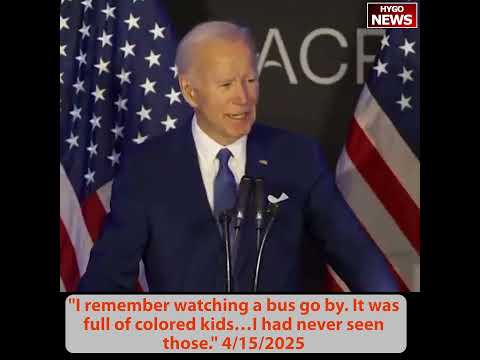
Biden’s Chicago Speech: Recounts Seeing “Colored Kids” on the Bus, Attacks Trump Administration — “So Much Damage in 100 Days”
Former President Joe Biden delivered his first major public speech since leaving office at the national conference of Advocates, Counselors and Representatives for the Disabled in Chicago in April 2025. Biden, 82, recounted a childhood memory of seeing “colored kids” on a bus in Delaware, saying: “I remember seeing kids going by at the time called colored kids and a bus going by. They never turned right to go to Claymont High School.” He attacked the Trump administration, declaring: “In 100 days this new administration has done so much damage and so much destruction. It’s kind of breathtaking it could happen that soon.” Biden also claimed 7,000 Social Security Administration employees had been pushed out the door and warned thousands more would follow.
”Colored Kids on a Bus”
Biden opened with a personal story from his childhood that drew immediate attention for its language.
“I remember pulling in, pulling into the parking lot, and I had never seen, I had never seen hardly any black people in Scranton at the time, and I was only going in 4th grade,” Biden said.
He continued: “And I remember seeing kids going by at the time called colored kids and a bus going by.”
Biden described asking his mother about the segregation: “They never turned right to go to Claymont High School. I wondered why. I asked my mom, why? So on Delaware, they’re not allowed to go to school and public school with white kids, honey.”
He claimed the experience motivated him: “That sparked my sense of outrage as a kid, just like it does.”
The “colored kids” anecdote was vintage Biden — a rambling personal narrative that mixed genuine civil rights sentiment with language that would have ended the career of any Republican politician who used it. Biden had a decades-long history of racially clumsy remarks, from telling a Black audience that Mitt Romney would “put y’all back in chains” to informing voters that “if you have a problem figuring out whether you’re for me or Trump, then you ain’t Black.” The Chicago speech added another entry to a catalog that the media had spent years explaining away or ignoring.
The story itself raised the familiar question of Biden’s relationship with truth in personal anecdotes. Over the decades, Biden had told numerous stories about his background that were later found to be embellished or fabricated — from claiming to have been arrested in South Africa visiting Nelson Mandela, to repeatedly misquoting his own academic record, to the evolving story of a house fire that grew in drama with each retelling.
”Simple Dignity”
Biden pivoted from the childhood story to a broader theme about dignity that formed the core of his message to the disability advocates.
“Your job’s about a lot more than a paycheck,” Biden said, quoting his father. “It’s about your dignity. It’s about respect. It’s about being able to look at your kid and say, honey, it’s going to be okay and mean it.”
He elevated the theme: “It’s about dignity. Simple dignity. Everyone, everyone deserves to be treated with dignity.”
Biden then connected the dignity message to the audience’s mission: “Regardless of their standard, regardless of their economic history, regardless of who they are, making sure that more than 60 million Americans who are living with disabilities are treated with dignity is who we are as Americans.”
He praised the advocates: “Laws like the ADA need advocates like you. You’re the ones that keep it going. God’s love you. You fight like hell every single day to make sure the law is respected.”
The dignity theme was Biden’s most effective rhetorical mode — the empathetic grandfather who understood suffering because he had experienced loss. But the delivery in Chicago reportedly included moments where Biden appeared to struggle with his words, trailing off mid-sentence and losing his place in the narrative. For a president who had been removed from his own party’s ticket over concerns about cognitive decline, the speech provided fresh evidence of the condition that had made his candidacy untenable.
Attacking the Trump Administration
Biden turned from inspiration to confrontation, directing his fire at the current administration.
“In 100 days this new administration has done so much damage and so much destruction,” Biden said. “It’s kind of breathtaking it could happen that soon.”
He targeted DOGE’s work at the Social Security Administration specifically: “They’ve taken a hatchet to the Social Security Administration, pushing 7,000 employees, 7,000 out the door in that time, including the most seasoned career officials.”
Biden warned of more to come: “Now they’re getting ready to push thousands more out the door. Already we can see the effects.”
The “100 days of damage” framing was the Democratic talking point of the moment, designed to counter the Trump administration’s narrative of rapid progress. Where the administration cited $150 billion in DOGE savings, falling energy costs, record military recruiting numbers, and manufacturing job growth, Biden characterized the same period as destructive.
The Social Security Administration staffing claim was a window into the broader disagreement about the purpose of the federal workforce. The Trump administration’s position was that agencies like SSA were bloated with redundant positions and that technology could deliver services more efficiently with fewer employees. Democrats argued that every federal employee performed an essential function and that any reduction in headcount would harm the public.
The Political Context
Biden’s emergence as an opposition voice was freighted with irony. The man who had been pushed aside by his own party because he was too diminished to campaign was now attempting to serve as the voice of Democratic resistance. The speech came at a moment when the party was struggling to find effective opposition to an administration that was executing its agenda with remarkable speed.
The choice of venue — a disability rights conference — was strategic. Disability advocates represented a constituency that felt directly threatened by DOGE’s restructuring of social service agencies. By speaking to this audience, Biden could cast himself as defending vulnerable Americans rather than simply opposing his successor.
But the speech also highlighted the Democrats’ leadership vacuum. Biden was 82 years old and had been deemed unfit to run for reelection by his own party’s leadership. Vice President Harris had lost the 2024 election. The Democratic bench in Congress was thin and divided. That Biden was the figure making the party’s case against Trump underscored the absence of a younger, more vigorous voice to lead the opposition.
The Screaming Moments
Multiple observers noted that Biden’s delivery included sudden shifts in volume — moments where the former president began shouting apparently without provocation.
“It’s about dignity. Simple dignity! Everyone! Everyone deserves to be treated with dignity!” Biden shouted during one of these episodes.
The sudden escalations in volume were a pattern that had become increasingly noticeable during Biden’s final year in office. They appeared to be an attempt to convey passion and conviction, but the effect was often jarring — a man going from a near-whisper to a shout within the same sentence, creating an impression of erratic energy rather than controlled emphasis.
For viewers who had watched Biden’s decline over the previous two years, the Chicago speech was confirmation that retirement from the presidency had not reversed the trajectory. The speech was intended to announce Biden’s return to public life; instead, it reinforced the reasons he had been forced to leave.
The 7,000 SSA Employees
Biden’s claim that 7,000 Social Security Administration employees had been “pushed out the door” in 100 days deserved scrutiny. The number was likely drawn from a combination of voluntary early retirement offers, attrition, and some reductions in force that DOGE had implemented across federal agencies.
The administration’s counter-argument was that SSA had been processing claims at chronically slow rates despite its headcount, that wait times for disability determinations stretched to months or years, and that a leaner workforce using modern technology could actually improve service delivery. The backlog of disability cases — the very issue that affected the audience Biden was addressing — had grown under the previous administration’s watch.
The irony was that the disability advocates Biden was addressing had been poorly served by the bloated bureaucracy he was defending. Wait times for disability determination had been a crisis for years. If DOGE’s restructuring could reduce those wait times through technological efficiency, the people in that Chicago conference room would be the primary beneficiaries.
Key Takeaways
- Biden, 82, delivered his first major post-presidency speech in Chicago, recounting seeing “colored kids” on a bus: “They never turned right to go to Claymont High School.”
- He attacked the Trump administration: “In 100 days this new administration has done so much damage and so much destruction. It’s kind of breathtaking.”
- Biden claimed 7,000 SSA employees were “pushed out the door” and warned “thousands more” would follow.
- He quoted his father on dignity: “Your job’s about a lot more than a paycheck. It’s about your dignity. It’s about respect.”
- The speech included sudden shouting episodes and struggles with delivery — reinforcing the concerns that ended his reelection campaign.