 HYGO News
 Joe Biden VERY QUICKLY got lost; proud Democrat wrong about Trump; Dem Stacey Abrams smears ICE
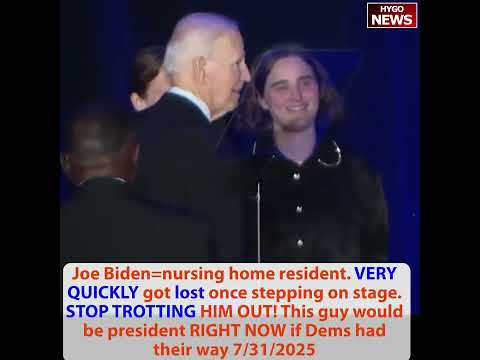
Joe Biden VERY QUICKLY got lost; proud Democrat wrong about Trump; Dem Stacey Abrams smears ICE
Four revealing vignettes from a single cycle. Former President Biden, at a public event, immediately got lost on stage. A caller who identified as “a proud Democrat” confessed on-air: “I’m not too proud to say that I am wrong about Trump … he’s done a lot of things. I’m happy about what’s happening with immigration. I thought the stock market would tank. I’m pretty happy with my 401k.” A second caller, also a Democrat who voted for Trump, thanked the Senate for meeting to “reunite us.” Stacey Abrams smeared ICE as “a secret federal police force” conducting “inhumane abductions and illegal deportations” while cataloging the $120 billion in “taxpayer money” the border bill allocates. And Rep. Ilhan Omar dodged a question about the Democratic agenda: “It makes no sense for a person running for office to pull out their agenda a year and a half before they are in an election year … people will pick it apart."
"Biden VERY QUICKLY Got Lost”
The opening. “And he brought his granddaughters to celebrate with him. Please be seated.”
A family introduction at what appears to be a Biden public event. Biden has brought his granddaughters to share the moment.
“Okay, so you’re going to be watching Biden’s remarks in full here. We saw Ben Jacobs on the horn here.”
Biden’s actual remarks were apparently brief and disoriented. The administration’s framing — “Joe Biden is basically a nursing home resident. He is speaking at some event and VERY QUICKLY got lost once stepping on stage” — captures what viewers saw.
“This guy would be president RIGHT NOW if Dems had their way.”
That is the counterfactual framing. Had the Democratic Party’s original 2024 plan held — Biden as the Democratic nominee — Biden would have faced Trump in the November 2024 general election regardless of his cognitive state. Democrats pushed Biden out only when his debate performance made continued candidacy politically impossible.
The framing: without the June 2024 debate performance, Democrats would have been willing to continue with Biden despite his visible decline. They switched to Harris not because they genuinely believed in her, but because Biden’s debate made continuation untenable.
”Proud Democrat Wrong About Trump”
A caller’s on-air confession. “I’m not too proud to say that I am wrong about Trump. I’m a proud Democrat and he’s done a lot of things. I’m happy about what’s happening with immigration. I thought the stock market would tank. I’m pretty happy with my 401k. There’s a few things that I just thought things would go wrong and I’m very happy.”
That is a specific piece of political reality. Americans who voted Democratic in 2024 — registered Democrats, self-identified Democrats — are looking at the 2025 outcomes and concluding the Trump administration is delivering things they wanted.
“Happy about what’s happening with immigration.” The border enforcement is producing the outcomes that many Americans, including many Democrats, wanted. The chaos of the Biden-era border has been replaced with enforcement and order.
“I thought the stock market would tank. I’m pretty happy with my 401k.” Pre-inauguration predictions were that Trump-era policies would produce market disruption. The opposite has occurred. Records have been set. 401(k)s have grown. The caller’s retirement assets have appreciated.
”Big of You to Say”
The radio host’s response. “Well, that is big of you to say. It’ll probably lose you some friends in this polarized environment that we’re in right now. But there’s nothing wrong with being happy with results no matter who gives them to you. Right? So I appreciate your candor.”
That is significant framing. The host is acknowledging the specific political courage required for a Democratic-identifying American to publicly state they were wrong about Trump. “Lose you some friends” reflects the social pressure against such admissions.
“There’s nothing wrong with being happy with results no matter who gives them to you.” That is the framework the host is endorsing. Partisan identification should not override empirical assessment. If the administration is producing results, acknowledging those results is rational regardless of which party controls the administration.
”Walking Up and Saying”
A second caller, David from Tamaqua, Pennsylvania. “David, what are you crying about? First of all, I’m a registered Democrat who voted for Trump. I thought this would never happen, but some of the Democratic Party is finally walking up and saying, President Trump is doing something good.”
“Walking up and saying” (likely meant “waking up and saying”). David is describing what he perceives as a shift in Democratic Party posture — some Democrats acknowledging Trump accomplishments rather than blanket opposition.
“They were meeting at a Senate meeting. What they’re doing is great. What they started doing is to reunite themselves and reunite us.”
David appears to be referring to a specific Senate event. The framing: Senate activity that reunites the parties and the country. Whether specific Senate developments warrant that characterization is less important than David’s interpretation.
“So please keep it up. Keep meeting. Keep talking. Keep fixing things. Keep you reminding us. And the party’s together. This will make our country stronger than ever in the world.”
“Keep fixing things.” That is the voter ask. Not more tribal politics. Fixing. Actual problem-solving. The administration’s operational tempo — trade deals, border enforcement, tax relief, peace deals — fits “fixing things” in a way that voters can recognize.
“I love it. Good for you. Good for you. Fix, fix, fix. I love it. Instead of telling us why the other guy’s worse, how do you make it better? Fix, fix, fix. You’re right. I’m with you, David.”
The host echoing David’s framing. “Fix, fix, fix.” That mantra — focus on fixes rather than attacks — captures a cross-partisan voter sentiment that polling has consistently documented.
Stacey Abrams on ICE
Stacey Abrams delivered the Democratic response framework. “Meanwhile, the bill allocates more than $46.5 billion for the Republican border wall. $45 billion more to expand immigrant detention facilities without investing in due process. And another $30 billion to hire and train ICE agents who have functionally become a secret federal police force with expanding domains.”
“$120 billion in taxpayer money” across border wall ($46.5 billion), detention facilities ($45 billion), and ICE agents ($30 billion).
“That’s over $120 billion in taxpayer money. And to put it into context, this is a budget larger than that of most militaries around the world, with all of these dollars being redirected towards inhumane abductions and illegal deportations.”
“Inhumane abductions and illegal deportations.” That is Abrams’s framing of ICE operations. The same rhetorical pattern Letitia James has deployed — characterizing lawful federal enforcement as illegal and inhumane.
“Budget larger than that of most militaries around the world.” That is the scale framing. $120 billion is indeed larger than many countries’ military budgets. Whether that comparison demonstrates appropriate scale for domestic enforcement or excessive scale is the political question.
The administration’s framing: the $120 billion is necessary because of the mass illegal-migration crisis Biden enabled. The Democratic framing: the $120 billion is excessive because ICE’s operations are, in their view, not legitimate.
”Functionally Become a Secret Federal Police Force”
“A secret federal police force with expanding domains.” That is Abrams’s characterization. ICE is not a publicly-known federal agency operating under federal statutes. It is, in her framing, a secret police force.
That characterization has consequences. Secret police are the instruments of authoritarian regimes — the KGB, the Stasi, the Gestapo, various other historical secret police. Characterizing ICE in that framework places the U.S. government in the category of authoritarian regimes and their enforcement apparatus.
Whether that characterization is accurate is the specific empirical question. ICE operates under federal law. ICE is subject to congressional oversight. ICE arrests are disclosed through court records and publicly-documented enforcement actions. ICE is not secret in any meaningful sense.
Abrams’s rhetorical escalation mirrors the Moulton “Gestapo” framing and the James “kidnapping” framing. Democratic Party voices are converging on language that frames American immigration enforcement as categorically illegitimate — not merely policy that could be reformed.
Ilhan Omar’s Strategy Dodge
Rep. Ilhan Omar addressed the question of the Democratic Party’s agenda. “It makes no sense for a person running for office to pull out their agenda a year and a half before they are in an election year. So your party’s agenda, the sensibility.”
That is Omar deflecting. The reporter is asking for the Democratic agenda. Omar is declining to provide one.
“We’re already… Yeah, but it just doesn’t work, sir. I see what you’re saying, but for those of us who work on campaigns, it just is really detrimental because people will pick it apart. And if you’re too late by the time you are an official candidate, none of what you were trying to concisely communicate with the people will be easy to do so.”
“People will pick it apart.” That is the strategic explanation. Omar is saying: if we announce what we want to do, voters will examine the specifics and reject them. Therefore we won’t announce what we want to do until campaign season, when we can control the messaging cycle.
That is a revealing framing. The standard argument against early agenda disclosure would be: our positions will change, and we don’t want to commit to specific positions this far from the election. Omar’s framing is different: our positions will be rejected if disclosed, so we will not disclose them.
“Strategy, strategy.”
Omar closing with the strategy framing. The rationale is electoral strategy, not substantive policy considerations.
The administration’s framing: this is what Democrats actually believe. Their agenda — as reflected in specific proposals like defunding ICE, preserving illegal immigrant benefits, expanding sanctuary protections, reversing Trump-era tax cuts — is politically unpopular when scrutinized. Democratic candidates are being coached to hide the agenda until the closing weeks of campaigns.
The Cumulative Pattern
Four items in a single cycle, each contributing to the same narrative. Biden’s cognitive state continues to generate viral moments that validate the administration’s “grossly incompetent” framing. Former Democratic voters are publicly acknowledging wrong predictions about Trump. Stacey Abrams is escalating anti-ICE rhetoric to “secret police.” Ilhan Omar is publicly admitting the Democratic agenda cannot be disclosed.
None of these items are the administration’s creation. They are Democratic Party outputs. The administration’s framing is simply to highlight and distribute them.
That editorial dynamic — the Democratic Party producing the material that validates conservative narratives about the Democratic Party — is one of the defining features of the current political environment. The administration’s allies do not need to manufacture content. They need to aggregate and distribute what Democrats are saying in real time.
Key Takeaways
- Joe Biden at a public event “VERY QUICKLY got lost” — the administration’s framing: “This guy would be president RIGHT NOW if Dems had their way.”
- A Democratic caller: “I’m not too proud to say that I am wrong about Trump … I’m happy about what’s happening with immigration. I thought the stock market would tank. I’m pretty happy with my 401k.”
- Stacey Abrams smeared ICE as “a secret federal police force” conducting “inhumane abductions and illegal deportations” — cataloging “$120 billion in taxpayer money.”
- A second caller, David from Tamaqua, PA: “I’m a registered Democrat who voted for Trump. I thought this would never happen, but some of the Democratic Party is finally walking up and saying, President Trump is doing something good.”
- Rep. Ilhan Omar declined to share the Democratic agenda: “It makes no sense for a person running for office to pull out their agenda a year and a half before they are in an election year … people will pick it apart.”