 HYGO News
 Joy Reid MELTS DOWN After Piers Morgan TORCHES Her for Playing the Race Card Over MSNBC Firing
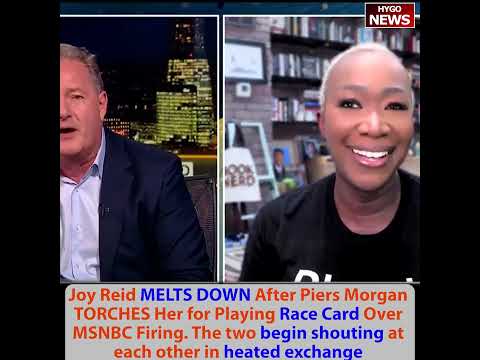
Joy Reid MELTS DOWN After Piers Morgan TORCHES Her for Playing the Race Card Over MSNBC Firing
Piers Morgan put former MSNBC host Joy Reid through one of the sharpest cable-TV interviews of the year on Piers Morgan Uncensored. The argument turned on whether Reid was fired from MSNBC because of declining ratings — roughly 47% below pre-election levels — or because, as Reid’s framing suggested, she was being punished for being a Black woman who said provocative things. Morgan delivered the blunt counter: “I don’t think you were fired after all those years because of your skin color or because you’re a black woman. I think you were fired because your show just got increasingly unpopular. It happens all the time in TV. That’s why you got let go. Why play the race card?” Reid’s response pivoted to accuse Morgan, as “a white European,” of being the one “fixated on trying to racialize conversations” — leading to an extended shouting match about whether Trump can be called fascist (Milley said so), whether Obama-was-a-black-president is “racializing” the conversation, and whether Reid’s own public theorizing about lost white viewers was itself racialized.
The Black Fascists Line
The segment opened with Reid in mid-argument. “Dynatralizing. That’s idiamine behavior. They’re the black fascists that you can compare it to.”
“Dynatralizing” appears to be a Whisper artifact — possibly “Democrat-neutralizing” or a similar phrase. “Idiamine” may be a reference to Idi Amin, the Ugandan dictator, suggesting Reid was comparing certain conservative Black political figures to Amin-style authoritarianism.
“They’re the black fascists that you can compare it to” is a specific rhetorical move Reid has deployed — labeling conservative Black political figures as “black fascists.” Whether that label survives scrutiny as political description or lands as inflammatory rhetoric depends on the audience. Morgan, predictably, did not let it pass.
”When You Lost Your Job at MSNBC”
Morgan pivoted to the firing. “When you lost your job at MSNBC, that’s what you’re saying. That… I’m sorry. That… That what I was doing… Hand value. Hand value.”
Reid’s emotional register in the clip is intense. “Hand value” appears to be Whisper’s rendering of “had value” — Reid asserting her show had value even as ratings declined.
“And in the end, I’m sorry, I try not to cry on TV. I’m not sorry. I’m just proud of my show.”
Reid’s admission of being on the edge of tears, quickly reversed with “I’m not sorry. I’m just proud of my show,” captures the emotional complexity of the moment. She was fired from the cable network she had worked at for years, from the prime-time slot she had built her career around, and the official reason has been delivered with the impersonal machinery of ratings decline.
The 47% Decline
Morgan raised the ratings data that MSNBC had reportedly circulated. “You know, a lot of people at NBC were briefing that the reason was declining ratings, post the election, 47% decrease in your election… in ratings from pre-election.”
A 47% ratings decline is substantial. Post-election ratings declines are common at cable news networks — audiences demobilize after the election cycle, and hosts who have defined themselves around election coverage are particularly vulnerable. For MSNBC specifically, the post-2024-election ratings environment has been difficult. The network’s core audience has been processing an outcome they did not want, and the response has been for some viewers to disengage rather than continue engaging with the coverage.
In that environment, hosts whose shows post especially steep declines become candidates for replacement. The decision is business, not personal. For Reid, who had been part of the network’s identity, the decision lands personally nonetheless.
The Ukrainians-vs.-Palestinians Theory
Morgan then introduced the specific episode that Reid herself had cited on another show as an inflection point. “But you told Martin Lamont Hill on his show this. After I said on my show that the reason Americans could relate to Ukrainians in a way that they didn’t relate to Palestinians, that Ukrainians are white. And so watching white people get their schools bombed was, you know, hit different. That hit our ratings.”
That is Reid’s own self-diagnosis from a conversation with Marc Lamont Hill. Her argument, on her MSNBC show, had been that American audiences sympathized more with Ukrainians than with Palestinians partly because Ukrainians are white. The observation about ratings: “We could see the loss of white viewers from that moment that I said that.”
That is the comment Morgan brought back. Reid herself had attributed part of her ratings decline to white viewers abandoning her show after she made the Ukrainians-Palestinians-whiteness observation. Reid did not deny the attribution. She extended it.
“And also I’m a black woman, so I mean, I’m sure he makes him angrier, you know, when I say things.”
“Makes him angrier” — the “him” being MSNBC executive leadership, or white viewers, or some combined audience — is the framing Reid used to explain why her show specifically bore the cost of the comment.
”Different Empathy Toward Other Global South People”
“As a black person, we have a different empathy toward other global South people when they are suffering.”
That is Reid’s articulation of her editorial stance. Her argument: her identity as a Black person produces a specific empathy toward non-white populations experiencing violence — Palestinians, for instance — that her audience of white MSNBC viewers did not share. That identity-based editorial perspective is, in Reid’s framing, what got her fired.
Morgan was not buying it. “I don’t think you were fired after all those years because of your skin color or because you’re a Black woman. I think you were fired because your show just got increasingly unpopular. It happens all the time in TV. That’s why you got let go. Why play the race card?"
"I Love the Fact That Your Play the Race Card Is Your Version of the Race Card”
Reid’s counter was to reverse the terms. “First of all, I love the fact that your play the race card is your version of the race card. You literally are so fixated on trying to racialize conversations with me, Piers. I find it actually quite challenging.”
That is a rhetorical move worth unpacking. Reid is arguing that Morgan’s use of the phrase “play the race card” is itself a form of racialized discourse — that Morgan is the one racializing the conversation by accusing her of doing so. The framing relies on the idea that raising the question of whether someone is playing identity politics is itself a form of identity politics.
Morgan rejected it directly. “You racialize more conversations in your stand-up… MSNBC, that you’re clipping data. Alright, Mark, can I get that this is your stick? Are you racialized? Everything, Joy, come on.”
“This is your stick” — Morgan’s charge is that Reid’s entire cable-news identity has been built on racializing topics that other hosts discuss in other framings. That framing worked commercially for Reid for years. The question, Morgan is asking, is whether it stopped working because audiences tired of it, not because MSNBC discriminated.
The White European Counter
Reid pivoted to Morgan’s identity. “Piers, we understand what it is. And it is so interesting to me that you yourself, as a white European, find that when people of color talk about race, that you believe is racializing conversations.”
That is the reversal. If Morgan, a white British broadcaster, is telling Reid, a Black American broadcaster, that she racializes conversations excessively, the reversal argument is that Morgan’s own position is one that benefits from not having to consider race. The argument — white people do not experience race as salient because their race is the default — is a standard progressive framing.
Morgan was not persuaded.
”Obama Was a Black President”
Reid pushed further. “But when people like you fixate on, well, Barack Obama was a black president. Why don’t you object to that? That is racializing a conversation about the former president of the United States.”
That is a misdirection. Noting that Obama was a Black president — a historically significant fact about American political history — is not generally considered racializing political discourse. It is a factual observation about a specific presidency.
“And I’m sure you find that charming and funny. I find it hilarious because you’re the one…"
"Trump Is a White Fascist”
Reid then pivoted to a direct charge about Trump. “You’re the one who said Donald Trump… You and your friend Donald Trump… You said Donald Trump is a white fascist.”
That was Reid’s own characterization of Trump, previously on her show. Morgan had clearly referenced it earlier in the conversation, before the transcript captured this segment.
“He is a… Well, I agree with Mark Milley. Obama did the same thing. Last time I checked, it’s not black. I’m not allowed to mention his skin color. I agree with his former chief of staff, who last time I checked was not black and said he’s fascist. And Mark Milley said he’s fascist to the core. So I happen to agree, and I know this is what it’s important to you, with two very white gentlemen about Donald Trump’s fascist tendencies. If that makes you sad and uncomfortable, I can’t help you.”
Reid’s defense: two white former senior military and administration officials — General Mark Milley (former Chairman of the Joint Chiefs) and Trump’s former White House Chief of Staff John Kelly — have used “fascist” to describe Trump. Reid is aligning with their characterization.
Whether “fascist” is accurate description of Trump is a political judgment, not a factual one. The former chairman and former chief of staff are entitled to their views. Reid citing them as cover for her own “white fascist” characterization is the defensive posture — if white senior officials said it, she can say it without being accused of playing race.
”I Think It Makes You a Little Bit of a Hypocrite”
Morgan’s closing line landed. “No, it doesn’t make me sad and uncomfortable. I think it makes you a little bit of a hypocrite, but that’s different.”
“Hypocrite” is the word Morgan chose to close the segment. The argument: Reid has built her career on racializing political discourse, but now objects when Morgan points out the pattern. Reid’s own theorizing about losing white viewers after her whiteness-of-Ukrainians comment validates, in Morgan’s framing, that Reid’s show was in fact defined by racialized commentary that drove viewer patterns — including the decline that led to her firing.
A Cable News Moment
The Morgan-Reid exchange is the kind of cable moment that gets clipped, shared, and re-argued for weeks. It is also the kind of moment that reveals something about the current media landscape. Reid was a major figure at MSNBC. Her firing is news. Her going on Piers Morgan’s show to process that firing is itself news. The exchange producing a high-temperature argument is, in the post-prime-time cable economy, what sustains audience attention.
Whether Morgan’s line of attack was unfair to Reid is a question Reid’s defenders will continue arguing. Whether Reid’s “race card” counter-framing worked is the question Morgan’s audience will continue arguing. The unresolved argument — on full display in the exchange — is one of the central features of contemporary American political discourse.
Key Takeaways
- Piers Morgan confronted Joy Reid about her MSNBC firing, rejecting the race-based explanation: “I don’t think you were fired after all those years because of your skin color or because you’re a black woman … You were fired because your show just got increasingly unpopular.”
- Reid’s own theory on her ratings decline: her Ukrainians-vs.-Palestinians whiteness comment caused “loss of white viewers from that moment I said that” — which she paired with being “a black woman.”
- Reid’s defense of her editorial posture: “As a black person, we have a different empathy toward other global South people when they are suffering.”
- Reid reversed on Morgan: “I love the fact that your play the race card is your version of the race card. You literally are so fixated on trying to racialize conversations.”
- On calling Trump fascist, Reid cited Gen. Mark Milley and John Kelly: “I happen to agree … with two very white gentlemen about Donald Trump’s fascist tendencies” — Morgan: “I think it makes you a little bit of a hypocrite.”