 HYGO News
 Kamala Suddenly Work Outside System; Sen Kennedy: Dems SPENDING CONCESSIONS in exchange for nominees
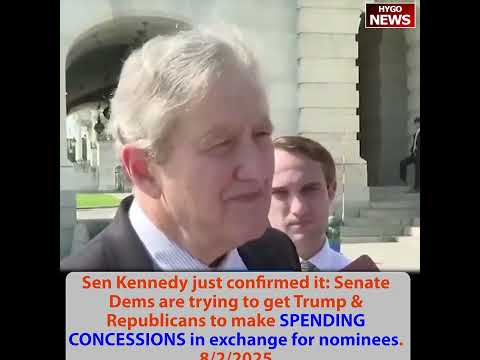
Kamala Suddenly Work Outside System; Sen Kennedy: Dems SPENDING CONCESSIONS in exchange for nominees
Three distinct accountability moments. CNN data analyst Harry Enten delivered a flat assessment of Kamala Harris’s decision not to run for California governor and her claim that she wants to work “outside the system”: “Oh, please! Not a chance on God’s green Earth.” Enten’s theory: Harris examined the 2028 primary polling and concluded “she would be the weakest front-runner since 1992.” Senator John Kennedy revealed what Senate Democrats are actually demanding in the current standoff: “The president is negotiating directly with Senator Schumer that Senator Schumer is demanding money … I don’t know whether it’s the budget or money to be released to universities or or what the terms are.” And Kennedy called out Sen. Patty Murray for making specific corruption accusations without specific evidence: “If you’re going to say someone has been bribed or someone is corrupt, you ought to be specific and I notice you haven’t been."
"Oh Please!”
CNN data analyst Harry Enten’s response to Harris’s decision not to run for California governor. “Can’t possibly believe that someone who was attorney general for a good period of time United States senator for a good period of time and then vice president for four years and then ran for president All of a sudden believes that the best way to solve it is from being outside the system Oh, please not a chance on God’s green earth that that’s necessarily the case.”
“Not a chance on God’s green earth.” That is Enten’s categorical rejection of Harris’s “outside the system” framing. Harris’s biography is the opposite of outside the system. She was California’s AG (inside the system). She was U.S. Senator (inside). VP (inside). Presidential nominee (inside). Every position she has held has been inside the formal political system.
The “outside the system” framing would make sense for a first-time candidate, a civic-movement leader, a business figure entering politics. It makes no sense for someone whose career has been entirely in state and federal elected office.
”She Saw the Polling Numbers”
“What’s probably going on is she saw what the polling numbers were perhaps for her running for governor of California. Yes, she has left open the idea that maybe she could run in 2028 for the Democratic nomination But I’ll tell you Abby. I’ve looked at those numbers. She would be the weakest front-runner since 1992.”
Enten’s analysis. Harris looked at two data sets:
- Polling for a potential 2026 California governor run
- Polling for a potential 2028 Democratic presidential primary
The California governor polling apparently showed her in a weaker position than expected. California is a heavily Democratic state. A former VP running for governor of her home state should be heavily favored. If the polling shows otherwise, it indicates Democratic voters in California have moved past Harris.
“Weakest front-runner since 1992” is the 2028 primary assessment. In 1992, Bill Clinton emerged as the Democratic primary frontrunner after multiple rounds of strong candidates had stumbled (Tsongas, Brown, Kerrey) or declined to run (Cuomo). The 1992 frontrunner position was weak. Harris’s 2028 position, per Enten, would be comparable.
“So the bottom line is this she’s looking at the numbers She knows what’s cooking and then all of a sudden, you know what actually this lifelong politician. I want to be outside This is a give me a break.”
Enten’s verdict. Harris looked at the data and concluded that neither path — governor nor president — was politically viable. The “outside the system” framing is the graceful exit narrative. It allows Harris to preserve political relevance without committing to a losing race.
That framing protects her options. “Outside the system” can mean anything. Book tour. Speaking engagements. Think-tank work. Corporate board positions. Memoir and legacy-building. Harris can pursue any of those while preserving her political viability for 2028 or 2032 if the political weather changes.
Kennedy on the Schumer Negotiation
Senator Kennedy revealed the specific Senate-standoff dynamics. “Some what Democrats are Demanding because it sounds like they are Negotiating or at least talking to leader my understanding and this is second-hand Is that the president is negotiating directly with senator Schumer that senator Schumer is demanding money That only the president can provide money for whatever I don’t know whether it’s the budget or money to be released to universities or or what the terms are But that’s what my understanding and that the president has said no so far.”
That is substantive. Trump is negotiating directly with Schumer. Schumer is demanding money. Specifically, money that only the president can provide — through budget negotiations, executive-action spending authority, or released funds to specific entities (like universities).
The university reference is notable. Higher-education funding has been a specific battleground — Columbia’s $200 million settlement, Harvard’s contested federal grants, broader DEI-related funding disputes. Schumer may be demanding that the administration release contested funds to universities in exchange for Senate confirmation cooperation.
“The president has said no so far.” Trump is not capitulating. He is not trading cash to Democrats for confirmation votes.
”Whip Us Until We Can’t Be Whipped”
Kennedy’s counsel to Senate Majority Leader Thune on how to handle the standoff. “What’s your guess if you just had to make a guess how long you guys stay here? I don’t know if you’d asked me yesterday I would have said we were coming together and maybe we’ll have a everybody will have a Pauline conversion and we’ll reach agreement today But my advice for what it’s worth to senator Thune is to just whip us Until we can’t be whipped anymore.”
“Whip us until we can’t be whipped anymore.” That is the internal-party-discipline recommendation. Whipping is Senate leadership’s process for ensuring members vote the party line. Kennedy is urging Thune to apply maximum whip pressure on Republicans to stay in Washington and keep voting until the Democrats concede.
“If everybody wants to play this game then make it as painful as he can for both sides until they cry like a Baby and say we’ll do whatever you want We’ll stand on one leg and bark like a dog if you tell us but don’t make us do this anymore But and and maybe he took my advice.”
Kennedy’s specific framing. Make the process as painful as possible for Democrats. Eventually they concede. The intermediate pain is the price of the eventual agreement.
”Second Coming”
“But it’s a waste of time. That’s the point. I’m trying to make I don’t mind doing it This is my job. I’ll stay here until the second coming if that’s what they want But it’s just a waste of time if we’re gonna stand stay here. Let’s work on something meaning Have a have a dog in this hunt.”
Kennedy acknowledging that he personally does not mind staying in Washington. But the time spent on partisan standoffs rather than substantive work is wasted time.
“Second coming” is Kennedy’s folksy framing. He will stay as long as needed. But the cost is that Senate time is not being used for productive legislation.
”We Ought to Be Driven by the Numbers”
“I think like senator McConnell We ought to be driven by the numbers then ought to be driven by the numbers You’ve got to have the numbers first.”
“Driven by the numbers.” That is the Kennedy-McConnell framework for senators on major votes. Votes should be decided by vote counts. If the votes are there, proceed. If the votes are not there, delay. Positioning ahead of vote counts is politically indulgent but operationally pointless.
Murray’s “Bribed” Accusation
Kennedy pivoted to calling out Sen. Patty Murray — the Senate Appropriations Committee vice chair. “I sat here this morning. I appreciate the bipartisan words But with all due respect madam vice chair when you say that the president United States has been bribed I said potential that’s pretty strong when you say that the director of the office of management in Budget is corrupt. It’s pretty strong.”
Murray apparently accused Trump of being “bribed” and OMB Director Russ Vought of being “corrupt.” Those are specific, damaging accusations.
“I think if you’re going to say someone has been bribed or someone is corrupt You ought to be specific and I notice you haven’t been.”
Kennedy’s demand for specificity. Accusations of bribery and corruption require specific claims — who bribed whom, for what, when, documented how. General characterizations without specifics are not accountability. They are political positioning that uses accountability language without accepting the burden of evidence.
“I’ve listened to a lot of pretty words about bipartisanship But then we get personal. I don’t think it’s productive. It’s up to you It’s America you can say and believe what you want But if you’re gonna say somebody’s been bribed you need to say Specifically by whom for what if you say Russ vote is corrupt I want to know what that means with all due respect.”
That is Kennedy’s explicit standard. Specificity or silence. If Murray wants to call Trump bribed and Vought corrupt, she owes evidence. If she does not have evidence, she should not make the accusations.
The Pattern of Unsupported Accusations
That Kennedy intervention matters. Democratic rhetoric has increasingly deployed serious accusations — bribery, corruption, treason, Gestapo-style operations, fascist governance — without specific evidence tied to specific conduct. Those accusations circulate in Democratic messaging without being tested against documentary or forensic standards.
Kennedy is pushing back. He is not saying Murray cannot have opinions. He is saying Murray cannot make accusations of specific crimes without specific supporting evidence. Those are different categories — opinions are protected political speech; accusations of specific crimes require evidentiary support.
If more Republican senators adopted Kennedy’s posture systematically — demanding specificity when Democratic colleagues deploy serious accusations — the rhetorical environment would shift. Democratic members would either have to document their claims or moderate their rhetoric.
Three Threads
Enten on Harris. Kennedy on Schumer’s cash demands. Kennedy on Murray’s unsupported accusations. Three different episodes, one common pattern.
Each involves Democratic figures making claims or taking positions that are politically motivated but not supported by evidence or logic. Enten is calling out Harris’s “outside the system” framing. Kennedy is calling out Schumer’s attempt to trade Senate votes for cash. Kennedy is calling out Murray’s corruption accusations without evidence.
Each intervention is a form of accountability pressure. CNN’s Enten is an internal Democratic-media accountability. Kennedy’s Schumer and Murray callouts are internal Senate accountability. Both matter for the broader political environment.
Key Takeaways
- CNN’s Harry Enten on Kamala Harris’s “work outside the system” framing: “Oh, please! Not a chance on God’s green earth that that’s necessarily the case … She would be the weakest front-runner since 1992.”
- Enten’s theory: Harris looked at the California governor polling and the 2028 primary polling and concluded both paths were politically unviable.
- Sen. John Kennedy revealed the current standoff: “The president is negotiating directly with Senator Schumer that Senator Schumer is demanding money … money that only the president can provide” — with Schumer targeting universities.
- Kennedy’s counsel to Thune: “Whip us until we can’t be whipped anymore … make it as painful as he can for both sides until they cry like a baby.”
- Kennedy challenged Sen. Patty Murray’s unsupported accusations: “If you’re going to say someone has been bribed or someone is corrupt, you ought to be specific and I notice you haven’t been.”