 HYGO News
 Mayor Bowser police dept down classing; Dems exact same problem statistics! Nadler Zohran Mamdani
Mayor Bowser police dept down classing; Dems exact same problem statistics! Nadler Zohran Mamdani
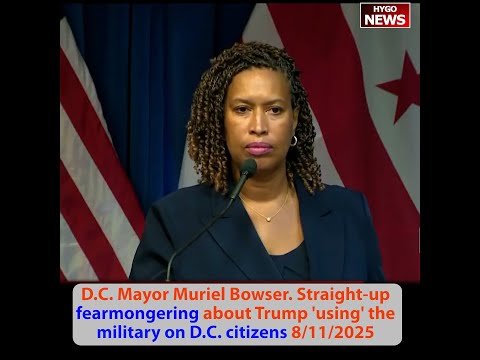
A multi-segment panel covering the DC crime statistics controversy, the national Democratic rhetorical trap on crime, Rep. Jerry Nadler’s endorsement of socialist Zohran Mamdani for New York mayor, and Mayor Muriel Bowser’s fear-driven warnings about federal military deployment. Former Rep. Peter Meijer: “I think Mayor Bowser may also know that there’s an ongoing investigation in her police department over the potentially manipulation of those statistics, that there had been a downclassing of some of the crimes, there’s been a massaging of the numbers in the reporting in order to fit them more beneficially into the FBI crime stats.” Alex Thompson: “National Democrats saying, ‘look at the statistics’ is sort of a tone deaf way to react.” Anderson Cooper: “Isn’t this the exact same problem that Democrats had last year? … ‘Look at the statistics! We promise you the economy is great’ while people are going, ‘it doesn’t feel great to me.’” Nadler for Mamdani: “We need Zorn Mamdani as mayor fighting against these betrayals right now.” And Bowser warning: “We don’t believe that our military should be used against American citizens."
"Down Classing” and Crime Stats Manipulation
Meijer’s specific allegation. “I think Mayor Bowser may also know that there’s an ongoing investigation in her police department over the potentially manipulation of those statistics, that there had been a down classing of some of the crimes, there’s been a massaging of the numbers in the reporting in order to fit them more beneficially into the FBI crime stats.”
“Down classing” is specific law-enforcement terminology. A violent crime — say, aggravated assault with serious injury — can be reported as a lesser offense — simple assault, for example. The actual event is the same. The classification used for the FBI Uniform Crime Reporting (UCR) system is different. Lower-classified reporting produces lower crime statistics without changing the underlying reality.
“Massaging of the numbers in the reporting in order to fit them more beneficially into the FBI crime stats.” That is the specific allegation. DC police have been reclassifying offenses in ways that reduce the apparent violent-crime rate. The FBI crime stats that Democrats are citing may reflect that reclassification rather than actual crime reduction.
If the allegation is substantiated, it is significant. It would mean the “30-year low violent crime” framing national Democrats are using is based on manipulated data. Actual crime may be stable or rising. Reported crime shows reduction because of classification practices rather than actual public safety improvement.
”National Democrats Are Not Paying Attention”
“So she may know some things that national Democrats are not paying attention.”
Meijer’s specific point. Mayor Bowser has local operational knowledge. She knows there is an investigation. She may know the underlying statistics are not fully trustworthy. National Democrats defending DC’s crime record are doing so without knowledge of what Bowser knows about the investigation.
That disconnect matters politically. If Bowser is publicly asking for more police and jail capacity while national Democrats are citing crime-stat declines, the Democratic messaging is internally inconsistent. One Democrat (the DC mayor) is saying crime requires more resources. Other Democrats (national figures) are saying crime is at 30-year lows. Both cannot be fully correct.
”30-Year Low” Versus “500 More Police Officers”
Alex Thompson’s analysis. “What’s striking is that national Democrats are not following Mayor Bowser’s lead on this and that national Democrats have been insisting, just look at the statistics. We have 30 year low violent crime, whereas Mayor Bowser is talking about, hey, we need to get 500 more police officers on the streets. We’d like the federal government to help us rebuild our jail. We also, she’s talking about some of the reforms she did to make it so accused violent offenders, don’t get out of jail pre-trial.”
That is the specific contradiction documented. Bowser’s operational asks:
- 500 more police officers
- Federal help rebuilding the DC jail
- Pre-trial detention reforms for accused violent offenders
Those are not the asks of a jurisdiction enjoying a 30-year crime low. Those are the asks of a jurisdiction facing significant public safety problems that require substantial additional capacity.
Bowser is, in effect, confirming the administration’s framing of DC’s crime problem. She is asking for precisely the kinds of interventions the federal government could provide. She is telling federal authorities that accused violent offenders have been released pre-trial — exactly the kind of policy failure that produces further victimization.
”Tone Deaf Way to React”
“So there is this disconnect and I’ve talked to Democratic strategists today that think that national Democrats saying, look at the statistics is sort of a tone deaf way to react.”
“Tone deaf.” That is Democratic strategists speaking on the record (to Thompson) about their own party’s messaging. National Democrats citing crime statistics while local Democrats ask for more police is a messaging failure. The voters who feel unsafe notice the disconnect. They trust the mayor’s operational asks more than the national politicians’ statistical framings.
Anderson Cooper: “Exact Same Problem”
Anderson Cooper’s analytical framing. “And it’s very much, isn’t this the exact same problem that Democrats had last year? ‘Look at the statistics. We promise you the economy is great.’ While people are going, ‘it doesn’t feel great to me.’”
That is the parallel. In 2024, Democrats cited economic statistics — low unemployment, GDP growth, stock market performance — while voters reported feeling economic pain from inflation, housing costs, and grocery prices. The statistical reality did not match the experienced reality. Voters trusted their own experience and rejected the Democratic candidate.
“That feels like a lot of this conversation around crime that you can point to statistics all day long that say, hey, DC is safer this year than it was last year, but do people feel safe? Bottom line, if they don’t, they may be more okay with something that would otherwise be considered extraordinary.”
The structural parallel. Statistics say DC is safer. Residents report feeling unsafe. The gap between statistics and experience produces willingness to accept “extraordinary” interventions — federal takeover of policing, National Guard deployment, federalization of DC governance. Measures that would otherwise be considered excessive become politically acceptable when voters feel unsafe regardless of the statistical narrative.
”Something That Would Otherwise Be Considered Extraordinary”
That phrase matters. Cooper is identifying the specific political dynamic that makes Trump’s DC federalization plausible. Under normal public-safety conditions, federalizing a major American city’s police would be politically radioactive. It would be characterized as authoritarian overreach.
Under conditions where residents feel unsafe and local governance has failed to restore their sense of safety, federal intervention becomes politically acceptable — even welcomed. Trump is not imposing federalization on a happy DC. He is proposing federalization to a DC whose residents are ready for “extraordinary” measures because ordinary measures have not worked.
The Democratic messaging mistake — citing statistics while voters feel unsafe — widens the window within which federal intervention is politically acceptable.
Nadler Endorses Mamdani
Rep. Jerry Nadler, Democratic congressman from Manhattan, endorsing Zohran Mamdani for New York mayor. “While we work to take back the House in 2026 and the White House in 2028, we need Zorn Mamdani as mayor fighting against these betrayals right now.”
“Zorn Mamdani” is Whisper’s slight miss. The actual name is Zohran Mamdani — the democratic socialist New York state assemblyman who won the Democratic primary for New York City mayor.
Nadler’s endorsement matters. Nadler is a senior Democrat — former House Judiciary Committee chairman, long-serving member of Congress, representative of a wealthy Manhattan district. His endorsement of Mamdani signals that institutional Democratic figures are willing to align with democratic socialists. The party’s center of gravity has shifted leftward.
”Won’t Flinch or Bargain Away Our Rights”
“Every seat matters. Every race matters. And who is mayor of New York is crucial. New York City needs a leader who won’t give Trump an inch, who won’t flinch or bargain away our rights. We Zorn Mamdani as mayor. We’ll have a leader who will defend our hospitals, our schools and our neighbors from Trump’s devastating policy.”
That is Nadler’s specific framing of Mamdani’s appeal. Mamdani as the anti-Trump mayor. Confrontation rather than cooperation with the federal government. Defense of hospitals (likely referring to federal healthcare policy disputes). Defense of schools (likely referring to federal education policy disputes). Defense of neighbors (likely referring to immigration enforcement).
Mamdani’s actual policy platform — rent freezes, free buses, city-owned grocery stores, significant tax increases on high earners — would face substantial resistance from New York’s business community and middle-class homeowners. Whether Nadler’s endorsement translates to Mamdani’s general election success is the New York political question.
Bowser’s “Uncharted Waters” Warning
Bowser’s response to federal military deployment concerns. “The president threatened to use not just the National Guard, but military to bring the United States and military, federal troops into the District of Columbia if needed. Can you respond to that threat?”
“I mean, we’re in uncharted waters already. A lot of people are seeing this as the first step in an assault on home rule, which the president has threatened. He’s been making these threats since last year and now he’s carrying through with them. There’s no reason to believe he won’t go further.”
“Uncharted waters.” That is Bowser’s framing. Federal military deployment to DC is unprecedented in recent history. “Home rule” is the specific legal framework — DC’s limited self-governance authority under the 1973 Home Rule Act. Federal intervention in DC policing or governance directly affects home rule.
“There’s no reason to believe he won’t go further.” That is Bowser’s escalation warning. Whatever federal intervention begins with, it may continue beyond the initial scope. Bowser is preparing DC residents for broader federal actions.
”Military Against American Citizens”
“What do you say to the president about his threats to bring the military, not just the National Guard, but the military? We don’t, I think I speak for all Americans. We don’t believe or believe it’s legal to use the American military against American citizens on American soil. I’m not a lawyer. I think that’s a fairly widely held fact.”
That is Bowser’s legal and political framing. Using American military against American citizens is, per Bowser, both illegal and widely rejected. The Posse Comitatus Act restricts federal military use for domestic law enforcement. National Guard deployment is different legally — but active-duty federal military deployment faces specific legal constraints.
“But we’ve seen them move, I think, the active military into California. So it is a question.”
Bowser citing California precedent. The administration deployed military personnel to California for immigration enforcement operations. That precedent, in Bowser’s framing, raises the question of similar DC deployment.
“We’ve seen active military on the borders of DC some years ago. And we don’t believe that our military should be used against American citizens.”
Previous DC-area military deployment (likely referring to Black Lives Matter protests period in 2020). Bowser’s position: military should not be used against American citizens regardless of the circumstances.
Three Democratic Vulnerabilities
The segment documents three specific Democratic political vulnerabilities. The crime statistics vulnerability (statistics vs. experienced safety). The party leftward shift (Nadler endorsing Mamdani). The federal intervention vulnerability (Bowser’s “military against citizens” framing that many voters may not share if federal intervention produces actual safety improvements).
Each vulnerability connects to the same underlying dynamic. Democratic messaging relies on statistical authority and rhetorical framings that do not match voter experience. Voters who feel unsafe accept interventions they would not otherwise accept. Voters who see Democratic politicians endorse socialists grow skeptical of the Democratic brand. Voters who see Democratic officials defend illegal-immigrant-enabling policies more than ICE-agent safety grow alienated from the party.
Key Takeaways
- Former Rep. Peter Meijer on DC police: “There’s an ongoing investigation in her police department over the potentially manipulation of those statistics, that there had been a down classing of some of the crimes … massaging of the numbers in the reporting in order to fit them more beneficially into the FBI crime stats.”
- Alex Thompson on Democratic messaging: “National Democrats saying, ‘look at the statistics’ is sort of a tone deaf way to react” — while Mayor Bowser asks for 500 more police, jail rebuild, and pre-trial detention reforms.
- Anderson Cooper identifying the 2024 parallel: “Isn’t this the exact same problem that Democrats had last year? ‘Look at the statistics! We promise you the economy is great’ while people are going, ‘it doesn’t feel great to me.’”
- Rep. Jerry Nadler endorsing Zohran Mamdani: “We need Zorn Mamdani as mayor fighting against these betrayals right now … a leader who won’t give Trump an inch, who won’t flinch or bargain away our rights.”
- Mayor Bowser on federal military: “We don’t believe or believe it’s legal to use the American military against American citizens on American soil … there’s no reason to believe he won’t go further.”