 HYGO News
 NY AG Letitia James demonizing masked ICE; Dem Khanna ousting Schumer, principle defends illegals
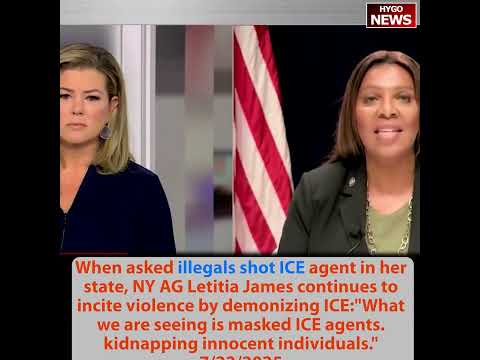
NY AG Letitia James demonizing masked ICE; Dem Khanna ousting Schumer, principle defends illegals
Four Democratic voices from a single news cycle, each revealing a different pressure point inside the party. New York Attorney General Letitia James — asked about the Border Patrol agent shot by the illegal-immigrant Miguel Francisco Mora Nunes in her state — deflected to denouncing “masked ICE agents without any insignia, without any identification, kidnapping innocent individuals.” Rep. Ro Khanna suggested replacing Senate Minority Leader Chuck Schumer, praising younger senators Cory Booker, Chris Murphy, and Brian Schatz as better equipped to “stand up to Donald Trump.” Khanna defended his vote against the Laken Riley Act as “standing up for principle” rather than “looking at where the political winds are going” — a principle that, in context, means siding against legislation that would detain unauthorized immigrants charged with theft-related crimes. And Omar Fateh, a Somali American, won the Minnesota Democratic Party endorsement for Minneapolis mayor over incumbent Jacob Frey, with a victory party that the administration’s allies noted visually resembled a different political context.
The James Deflection
The reporter’s question to Attorney General Letitia James was direct. “Voters make a distinction. A lot of them in the polls show it between undocumented immigrants without criminal records, but you’re talking about and those who have them, especially in these extreme cases, like we look at in this case in New York City, in this case, why should those voters think that this is something other than the system not working?”
That is the question. When Miguel Francisco Mora Nunes — a four-times-arrested, multi-state-wanted criminal illegal alien — is released by sanctuary policies and ultimately shoots a federal officer, what framing makes that outcome anything other than the system failing?
“I mean, if you’re talking about waiting for comprehensive immigration reform, they’ve been trying for a long time, it doesn’t happen. In the case of cities taking a step is and states taking a step, is this an example where there could be that coordination instead of waiting decades for Congress to act.”
The reporter was inviting James to engage with the specific case. To acknowledge that coordination with federal immigration enforcement — which sanctuary policies explicitly prevent — might be a legitimate tool for the specific category of repeat-offender illegal immigrants the Mora Nunes case represents.
”Our Neighbors … Trying to Make Ends Meet”
James’s answer did not engage with the Mora Nunes case specifically. “Individuals who are our neighbors, individuals who unfortunately are just trying to make ends meet each and every day.”
That is the collective framing. James is talking about “individuals who are our neighbors … trying to make ends meet” as the population at stake. But the question was specifically about Mora Nunes — who had been arrested four times in New York City, who had an active Massachusetts armed-robbery warrant, who had kidnapping and witness intimidation charges, who shot a Border Patrol agent. That individual is not a neighbor trying to make ends meet. That individual is a violent criminal with a long rap sheet.
“Both of these individuals had had multiple arrests after deportation orders.”
James conceded the specific reality of multiple arrests post-deportation orders. That acknowledgment is damaging to the sanctuary-policy framing. If individuals with deportation orders are being released after multiple arrests, the system is specifically failing to enforce existing deportation orders through municipal non-cooperation with ICE.
“Why are those not opportunities?”
James’s question — “why are those not opportunities” — asked in response to the reporter’s invitation to consider state-local coordination with ICE, is rhetorical. But it implicitly concedes that the Mora Nunes pattern represents a failure of non-coordination.
”Kidnapping Innocent Individuals”
James then pivoted back to the anti-ICE framing. “The vast majority of individuals who are being secreted and kidnapped at night are individuals who again are facing civil deportation and not criminal enforcement.”
“Secreted and kidnapped” — that language for ICE enforcement is extraordinary from a sitting state attorney general. “Kidnapped” implies illegal abduction. ICE operations, whatever one thinks of their policy merit, are conducted under lawful federal authority with legal predicate for each individual targeted.
“It’s important that we make a distinction. It’s important that individuals understand that individuals are being caught up in these ICE raids, innocent individuals, students, teachers, small businesses.”
Students, teachers, small business owners — the sympathetic categories James is invoking. Whether those are the actual primary targets of ICE operations, or whether they are a smaller subset that can be used for sympathetic framing, is the factual dispute. The Mora Nunes case is on one end of the spectrum. The student-teacher-small business owner is the other end. ICE enforcement, as it actually operates, covers a wider range than either pole.
“We all want the same thing and that is to protect individuals from harm. But unfortunately, what we are seeing is mass ICE agents without any insignia, without any identification, kidnapping innocent individuals that both you and I know.”
“Mass ICE agents without any insignia, without any identification, kidnapping innocent individuals” is the escalation from legitimate criticism to rhetorical characterization that approaches incitement. A state attorney general, whose office has authority to direct law enforcement resources and prosecutorial priorities, using “kidnapping” to describe federal law enforcement activity is extraordinary.
Khanna on Schumer
Rep. Ro Khanna turned to a different Democratic internal fight. “I think that Chuck Schumer was a very skilled legislator under Biden to pass legislation, but that’s not what the Times call for.”
“Not what the Times call for” is Khanna’s diagnosis of the Schumer problem. Schumer’s skill is legislative technique — building coalitions, passing bills, managing the floor. Khanna is arguing the political moment requires something different: confrontational posture, willingness to block, ability to stand up to Trump publicly.
“Right now, the Times call for someone who’s going to stand up to Donald Trump and make sure that we stand up to this unconstitutional action. And we’ve had great voices in the Senate doing that. We’ve had Cory Booker doing that. We’ve had Chris Murphy doing that. We have so much talent there, Brian Chats doing that, that it just seems to me odd that we still are picking Schumer.”
Booker, Murphy, Schatz. Those are the three Khanna names as alternatives to Schumer. Each has a different profile — Booker (New Jersey, race-attacker of Waltz), Murphy (Connecticut, tech-critical progressive), Schatz (Hawaii, outspoken climate and tech voice). All three are more progressive and more confrontational than Schumer.
“I mean, I have nothing to do with it. It’s the Senate’s decision.”
The disclaimer. Khanna is a House member; Senate leadership decisions are the Senate’s. But having raised the name question publicly, he has injected the leadership challenge into the Democratic conversation regardless.
”Make It Clear for September 30th”
“But what we need to do is make it clear for the September 30th that he shouldn’t capitulate, that he needs to stand with the base and make sure we get some concrete concessions.”
September 30th is the end of fiscal year 2025 and the typical appropriations cliff. Khanna is warning that Schumer should not “capitulate” on the spending fight — should not accept a Republican-favorable appropriations deal in exchange for keeping the government open. He should “stand with the base and make sure we get some concrete concessions” — meaning, Khanna is calling on Schumer to be willing to allow a government shutdown as leverage.
”Principle” Against Laken Riley
“And I spoke out and voted against the Lake and Rylee Act. I got a lot of criticism, but I’m always consistent in standing up for principle and not just looking at where the political winds are going.”
The Laken Riley Act — named for the 22-year-old Georgia nursing student murdered by an illegal immigrant — mandates detention for unauthorized immigrants charged with theft-related crimes. It passed with bipartisan support.
Khanna voted against it. He characterizes his vote as “principle” rather than political wind-reading. The “principle” in question is opposition to mandatory detention for specific crimes committed by unauthorized immigrants.
That is a principled position — many progressives genuinely believe mandatory detention laws are a moral wrong regardless of political cost. But the specific application — opposing a law named for a murder victim, which requires detention only for those charged with crimes — is a position that will not survive political scrutiny if the issue turns into a general-election argument.
Omar Fateh Wins the Minneapolis Democratic Endorsement
The segment closed with a Minnesota story. Omar Fateh, a Somali American state senator, won the Minnesota Democratic Party endorsement for Minneapolis mayor over incumbent Jacob Frey.
Fateh’s speech included a passage capturing his positioning. “We should make dua for him and pray for him. I understand that our Somali communities are all connected to each other here in Minnesota and back home and ask for your support. There’s always been a link between our community here as well as back home. And I’m running to bridge that gap and unite all of us and represent all of us because when we succeed here, we succeed everywhere. And I’m hoping to do that just like Abdu’l-Zak, inshallah.”
The content is notable: explicit appeal to the Minnesota Somali community, reference to “back home,” and Islamic religious invocations (“make dua,” “inshallah,” “Abdu’l-Zak”).
The Minneapolis Victory Party
The video circulated with commentary: “Mogadishu? Nope. Minneapolis victory party of Omar Fateh after he won the MN Democratic endorsement.”
The framing is calibrated for viewers who will find the victory party imagery — Somali-majority crowd, Islamic prayer, cultural context distinct from mainstream American political events — worth noting. That calibration is ethically complicated. Diverse political coalitions produce diverse victory events. The point the administration’s allies are making is not that Somali Americans should not participate in Minnesota politics. It is that the Democratic Party’s coalition, once the reliable home of Midwestern working-class voters, has shifted dramatically, and that shift matters for the party’s general-election competitiveness.
Jacob Frey — the Democratic incumbent mayor Fateh defeated for the party endorsement — will still likely stand for reelection, possibly as an independent or possibly withdrawing. The split within the Minneapolis Democratic Party over Fateh vs. Frey is one of many fractures the Democrats are absorbing.
Five Threads, One Fracture
James’s Border Patrol deflection. Khanna’s Schumer replacement. Khanna’s Laken Riley vote. Fateh’s Minneapolis endorsement. All are pressure points in the Democratic coalition. The party’s older, more centrist, more legislatively experienced wing — represented by Schumer, Frey, and others — is being actively challenged by a younger, more progressive, more confrontational wing — represented by Khanna’s alternatives, Fateh, and others.
Whether the party absorbs these internal challenges and emerges with a coherent 2028 platform is the question. Whether the administration’s allies can continue to surface Democratic internal voices saying things that the general electorate will reject is the ongoing editorial campaign.
Key Takeaways
- NY Attorney General Letitia James, asked about the Mora Nunes case where a Border Patrol agent was shot: deflected to denouncing “mass ICE agents without any insignia, without any identification, kidnapping innocent individuals.”
- James conceded: “Both of these individuals had had multiple arrests after deportation orders” — a specific acknowledgment of sanctuary-policy failure.
- Rep. Ro Khanna suggested replacing Chuck Schumer as Senate leader, praising Booker, Murphy, and Schatz as better equipped to “stand up to Donald Trump.”
- Khanna defended voting against the Laken Riley Act as “standing up for principle and not just looking at where the political winds are going.”
- Omar Fateh won the MN Democratic Party endorsement over incumbent Mayor Jacob Frey — his victory speech citing “our Somali communities … here in Minnesota and back home” with Islamic religious invocations (“inshallah,” “make dua”).