 HYGO News
 Q:"Did they fail you?" LA fire chief: "Yes." As Gov. Newsom turns on LA officials for no water
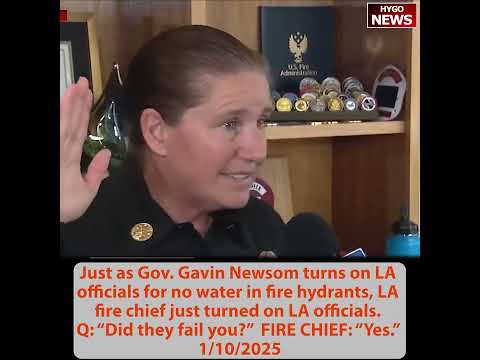
Q:“Did they fail you?” LA fire chief: “Yes.” As Gov. Newsom turns on LA officials for no water
As the finger-pointing intensified over the Los Angeles wildfire response in January 2025, a reporter asked the LA fire chief a direct question: “Did they fail you?” The chief’s one-word answer — “Yes” — marked a decisive moment in the accountability debate. The exchange came as Governor Gavin Newsom shifted blame toward Los Angeles city officials for the failure to maintain water in the fire hydrants, turning on the very local leaders he had previously defended.
The Fire Chief’s One-Word Verdict
The exchange between the reporter and the LA fire chief was brief but devastating. When asked whether Los Angeles officials had failed the fire department, the chief answered simply: “Yes.”
The admission was remarkable for its directness. Fire chiefs typically navigate politically sensitive questions with diplomatic language, especially during an ongoing emergency. But the scale of the failures during the Los Angeles wildfires — dry fire hydrants, depleted reservoirs, insufficient staffing — had apparently pushed the department’s leadership past the point of political caution.
The “yes” confirmed what firefighters on the front lines had been experiencing throughout the crisis: they had been sent to fight historic blazes without the basic infrastructure they needed. Fire hydrants across multiple neighborhoods had run dry, forcing crews to rely on water tankers and mutual aid from other jurisdictions while homes burned.
Newsom Turns on LA Officials
The fire chief’s admission came at a particularly charged political moment. Governor Gavin Newsom, who had previously stood alongside LA Mayor Karen Bass and other local officials in a show of unity, had begun redirecting blame toward the city-level leadership.
Newsom’s shift was significant. Just days earlier, President Biden had told Newsom he was “getting a bad rap” about the fire hydrants and offered an explanation centered on utility power shutoffs. But as public anger intensified and the political costs mounted, Newsom began to distance himself from the local officials whose decisions had contributed most directly to the infrastructure failures.
The governor’s pivot toward blaming LA officials for the lack of water in fire hydrants represented a fracturing of the unified front that California’s Democratic leadership had initially attempted to maintain. With the incoming Trump administration and Republican critics pressing hard on the failures, the political alliance between Sacramento and Los Angeles City Hall began to crack under the pressure of accountability.
The Fire Hydrant Crisis
The fire hydrant failures had become the single most damaging symbol of governmental incompetence during the wildfire crisis. Across multiple neighborhoods in the Pacific Palisades and surrounding areas, firefighters had connected hoses to hydrants only to find little or no water pressure. The images of dry hydrants and helpless firefighters had been broadcast nationally and shared widely on social media.
Multiple factors contributed to the problem. The Los Angeles Department of Water and Power had struggled to maintain pressure in the system as demand surged from firefighting operations across the city. A major reservoir in the Pacific Palisades area had been taken offline for maintenance and was not available when the fires struck. Utility companies had cut power to prevent downed lines from starting additional fires, which in turn shut down the electric pumps that maintained water pressure in the system.
But beyond the technical explanations, the underlying issue was one of preparedness and prioritization. The fire department had repeatedly raised concerns about water infrastructure in high-risk fire areas, and those concerns had not been adequately addressed by city leadership. Mayor Bass’s $17 million in cuts to the fire department budget, combined with deferred maintenance on water infrastructure, had left the system unable to perform its most basic function during the worst-case scenario that had now arrived.
The Accountability Fracture
The fire chief’s public admission that city officials had failed the department opened a new phase in the wildfire accountability debate. With the chief’s confirmation on record, it became significantly harder for LA city officials to maintain that the failures were entirely the result of unprecedented weather conditions or factors beyond their control.
The exchange also changed the political dynamics between the state and city governments. Newsom’s decision to redirect blame toward LA officials suggested that the governor had calculated that defending the local response was a political liability he could no longer afford. By separating himself from the city-level failures, Newsom could attempt to position the state’s response as adequate while characterizing the breakdowns as localized to Los Angeles city government.
For the fire department itself, the chief’s admission served as a public declaration that the department had been set up to fail by the officials responsible for maintaining the infrastructure they depended on. The “yes” was a statement of professional frustration as much as political commentary.
Key Takeaways
- When a reporter asked “Did they fail you?” the LA fire chief answered “Yes,” confirming that city officials had failed the fire department during the wildfire crisis.
- Governor Newsom shifted blame toward Los Angeles city officials for the fire hydrant failures after previously presenting a unified front with local leaders.
- The fire hydrant crisis — with dry hydrants across multiple neighborhoods — had become the defining symbol of governmental failure during the wildfires.
- The fire chief’s public admission opened a new phase in the accountability debate and fractured the political alliance between state and city leadership.