 HYGO News
 Trump: Some EU helpful, some not. Germany=great, Spain =terrible cut off all dealings with Spain. UK
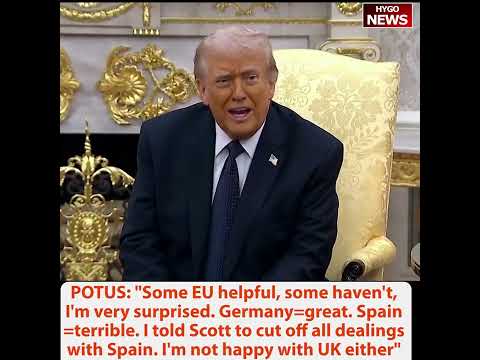
Trump: Some EU helpful, some not. Germany=great, Spain =terrible cut off all dealings with Spain. UK
President Trump delivered sharp assessment of European nations after U.S. action on Iran. Germany and most European nations helpful. Spain “terrible” — only NATO nation refusing 5% defense spending commitment, refused U.S. base use. Trump directed Treasury Secretary Scott Bessent to “cut off all dealings with Spain.” Trump: “Spain has absolutely nothing that we need other than great people. They have great people. But they don’t have great leadership.” Trump also “not happy with UK” over island base lease (Diego Garcia issue). UK took 3-4 days to coordinate landing rights. “This is not Winston Churchill that we’re dealing with.” On Iran: “It’s been 47 years. They’ve been killing people all over the world for a long time.” Iran as “kings and fathers of the roadside bomb” — 95% of IED deaths/maimings of American troops from Iran. Trump noted Soleimani killed in first term was critical. Iran’s record: hostages, barracks attacks (Beirut 1983), global terror sponsorship, many American limbs/lives lost. Trump: “Spain has absolutely nothing that we need other than great people. They have great people. But they don’t have great leadership. And as you know, they were the only country that in NATO would not agree to go up to 5%.” On Iran: “They did the roadside bombs. 95% of the people lost their legs arms, had their face wiped out, just wiped out. I’ve seen some young people that it’s so sad to watch. And that was almost 95% comes from Iran.”
European Assessment
Trump opened with mixed review of European nations. “Some of the European nations have been helpful and some haven’t. And I’m very surprised. Germany has been great. He’s been terrific.”
German Chancellor Friedrich Merz has been supportive of Trump’s approach. Germany’s cooperation on:
- Iran actions
- Ukraine support
- NATO 5% commitments
- Trade frameworks
“Others have been very good, terrific. I think that the head of NATO, Mark, is fantastic. Mark Rutte. I think he’s fantastic.”
Mark Rutte (former Dutch PM, current NATO Secretary General) has effectively coordinated NATO responses to Trump administration priorities including the 5% defense spending commitment.
Spain “Terrible”
“But some of the European, like Spain, has been terrible. In fact, I told Scott to cut off all dealings with Spain.”
Trump’s framework: Spain stands out for uncooperation.
“First of all, it started when every European nation, at my request, paid 5%, which they should be doing. And everybody was enthusiastic about it. Germany, everybody. And Spain didn’t do it.”
The 5% defense spending commitment:
- Every NATO nation agreed to reach 5% of GDP for defense
- Germany, UK, France, Italy, Poland, etc. committed
- Spain refused
- Only NATO holdout
Spain Blocking Bases
“And now Spain actually said that we can’t use their bases. And that’s all right. We could use their base if we want. We could just fly in and use it. Nobody’s going to tell us not to use it. But we don’t have to.”
Spain denied U.S. access to Rota Naval Station and Morón Air Base. These had been important strategic assets for U.S. operations in Europe, Mediterranean, and beyond.
Trump’s framework:
- Could use bases by fiat (“just fly in”)
- Chose not to
- Spain’s choice doesn’t constrain U.S. ultimately
“But they were unfriendly. And so I told them we don’t want to.”
The political point: Spain’s unfriendliness warrants response, not just compliance.
”Cut Off All Trade”
“Spain has absolutely nothing that we need other than great people. They have great people. But they don’t have great leadership.”
Trump distinguishing:
- Spanish people (great)
- Spanish leadership (not great)
- PM Pedro Sánchez (Socialist) adversarial to Trump
“And as you know, they were the only country that in NATO would not agree to go up to 5%. I don’t think they would have agreed to go up to anything. They wanted to keep it at 2%. And they don’t pay the 2%.”
Spain’s defense spending problem:
- Commitment: 2% of GDP (original NATO target)
- Refused 5% upgrade
- Doesn’t reliably meet 2%
- Essentially freeloading on NATO
“So we’re going to cut off all trade with Spain. We don’t want anything to do with Spain.”
Trade cutoff from U.S. to Spain. Economic pressure.
Spain’s economic vulnerability:
- U.S.-Spain trade significant
- Spanish agricultural exports important
- Financial services connections
- Corporate linkages
UK Issue
“I’m just asking, what is the expectation of what’s going on? By the way, I’m not happy with the UK either.”
Trump pivots to UK criticism.
“That island that you read about, the lease. For whatever reason, he made a lease of the island. Somebody came and took it away from him.”
Trump reference to Diego Garcia / BIOT (British Indian Ocean Territory). UK had leased Diego Garcia atoll to U.S. for strategic base. UK-Mauritius agreement complicated status.
“And it’s taken three, four days for us to work out where we can land there. It would have been much more convenient landing there as opposed to flying many extra hours.”
The base access delays cost operational time. During Iran operations, every hour mattered.
“So we were very surprised. This is not Winston Churchill that we’re dealing with.”
Trump comparing UK PM (likely Starmer) unfavorably to Winston Churchill. The implicit: UK leadership weak compared to WWII leadership.
Iran Context
“Something had to be done. And it’s been 47 years. They’ve been killing people all over the world for a long time.”
1979 Iranian Revolution = 47 years of Iranian terrorism. Iran’s track record:
- Hostage crisis (1979-1981)
- Beirut barracks bombing (1983)
- Various hostage-takings
- State-sponsored terrorism
- Proxy wars
- Nuclear program
- Regional destabilization
“They would be the kings and fathers of the roadside bomb.”
Iranian IEDs (Improvised Explosive Devices):
- Supplied via Iranian Revolutionary Guard
- Delivered to Iraqi Shia militias
- Used against U.S. troops
- Thousands of American casualties
Soleimani Framework
“Salomeini, we killed him last time. If we didn’t, I think it might be a different story today. They would have been much stronger and smarter than they are.”
General Qassem Soleimani killed January 3, 2020 (Trump first term). Soleimani was:
- Head of Iranian Quds Force
- Coordinator of regional proxy operations
- Major figure in Iranian military
- Responsible for many U.S. troop deaths
Killing Soleimani disrupted:
- Iran’s regional operations
- IED supply chains
- Proxy coordination
- Strategic planning
95% of IED Casualties
“But they did the roadside bombs. 95% of the people lost their legs arms, had their face wiped out, just wiped out.”
Iranian IEDs caused approximately 95% of:
- Leg losses (U.S. troops)
- Arm losses
- Facial injuries
- Combat deaths from explosive devices
“I’ve seen some young people that it’s so sad to watch. And that was almost 95% comes from Iran.”
Trump acknowledges personal contact with wounded veterans. The emotional weight of meeting amputees from Iranian IED attacks.
“And Salomeini loved his favorite weapon. He loved the roadside bomb.”
Soleimani personally championed IED warfare against U.S. forces.
”When You See People Walking Around”
“When you see people walking around with no legs and no arms and a face that’s been blown to hell, these people know what they have to go and the way they have to live.”
Trump’s framework: meeting actual IED victims changes perspective.
“This is Iran.”
Direct attribution: Iran’s fingerprints on every IED-wounded veteran.
Full Iran Record
“When you look at the barracks, the famous barracks, when you look at the hostages, when you look at a lot of hostages, when you look at all of the problems, they were really a purveyor of terror all over the world for many, many years.”
Trump enumerated Iranian acts:
- Barracks (Beirut 1983, 241 U.S. Marines killed)
- Hostages (1979-1981, 52 U.S. diplomats held)
- Other hostages (Lebanon, subsequent)
- Terror sponsorship globally
“And it’s something that had to be done, something.”
The justification framework: action was necessary given history.
”Different Story If Didn’t”
“And I believe that if we didn’t, because I see we’re Congress, if I didn’t do this, guys like Schumer, who are the losers, the Democrats, the losers, that’s why they’re not here, guys like Schumer would say, well, you should have done this.”
Trump’s framework:
- Schumer/Democrats absent from discussion
- If Trump hadn’t acted, Democrats would criticize for inaction
- Trump acts, Democrats criticize
- Damned either way
“In other words, if I did it, it’s not good. If I didn’t do it, they would have said the opposite, that you should have done this.”
Classic Democratic rhetoric — criticize whatever Trump does. Trump notes the lose-lose framework they create.
”Never Had More Compliments”
“But most people feel, I’ll tell you what, I have never had more compliments on something I did. People felt it’s something that had to be done.”
Trump’s framework: public support strong for Iran action. Specifically:
- Veterans appreciating action
- Allies supporting
- Regional partners relieved
- American public favoring decisive action
Oil Prices
“So if we have a little high oil prices for a little while, but as soon as this ends, those prices are going to drop, I believe lower than even before.”
Iran’s military degradation could:
- Reduce regional instability
- Reduce Iranian oil production for proxies
- Stabilize Middle East
- Actually lower oil prices post-conflict
Historical pattern:
- War scares raise oil prices
- Resolution lowers them
- Reduced Iranian threat = longer-term lower prices
Significance
The comprehensive framework:
-
European sorting: Cooperative (Germany, Netherlands) vs uncooperative (Spain, UK)
-
Spain punishment: Trade cutoff for refusal to meet NATO obligations
-
UK concern: Diego Garcia delay prompts Churchill comparison
-
Iran action justified: 47 years of terror, 95% IED casualties
-
Public support: Trump claims strong positive reception
The Spain trade cutoff is substantial. Spain’s leadership under Sánchez has been:
- Hostile to Israel (ICJ joining)
- Reluctant on NATO commitments
- Opposing Trump policies
- Leftist framework aligned with anti-U.S. positions
U.S. response: economic consequences.
The UK criticism is notable. Starmer (Labour) has been more supportive than some expected, but the Diego Garcia issue frustrated Trump. Churchill comparison signals disappointment with perceived weakness.
The Iran framework justifies recent actions:
- Military strikes on Iranian assets
- Leadership elimination
- Naval destruction
- Infrastructure damage
47 years of Iranian terrorism against U.S. and allies:
- Thousands of American deaths
- Tens of thousands wounded
- Regional destabilization
- Nuclear threat
Trump’s framework: sufficient justification for decisive action.
Key Takeaways
- Trump on Spain: “Spain has been terrible. In fact, I told Scott to cut off all dealings with Spain … Spain has absolutely nothing that we need other than great people. They have great people. But they don’t have great leadership. And as you know, they were the only country that in NATO would not agree to go up to 5% … So we’re going to cut off all trade with Spain.”
- Trump on UK: “I’m not happy with the UK either. That island that you read about, the lease … it’s taken three, four days for us to work out where we can land there. It would have been much more convenient landing there as opposed to flying many extra hours. So we were very surprised. This is not Winston Churchill that we’re dealing with.”
- Trump on Iran history: “Something had to be done. And it’s been 47 years. They’ve been killing people all over the world for a long time. They would be the kings and fathers of the roadside bomb.”
- Trump on IED casualties: “95% of the people lost their legs arms, had their face wiped out, just wiped out. I’ve seen some young people that it’s so sad to watch. And that was almost 95% comes from Iran. And Salomeini loved his favorite weapon. He loved the roadside bomb.”
- Trump on public support: “Most people feel, I’ll tell you what, I have never had more compliments on something I did. People felt it’s something that had to be done.”